MATLAB and Simulink continue to be powerful tools for modeling, simulation, and system design across engineering domains. From electric vehicles to smart grids and AI-driven automation, MATLAB simulation is playing a critical role in modern research and industry applications.
As we move into 2026, several advanced topics are emerging as highly trending in academia, research, and industrial development. This article explores the most in-demand MATLAB simulation topics and why they are gaining popularity.
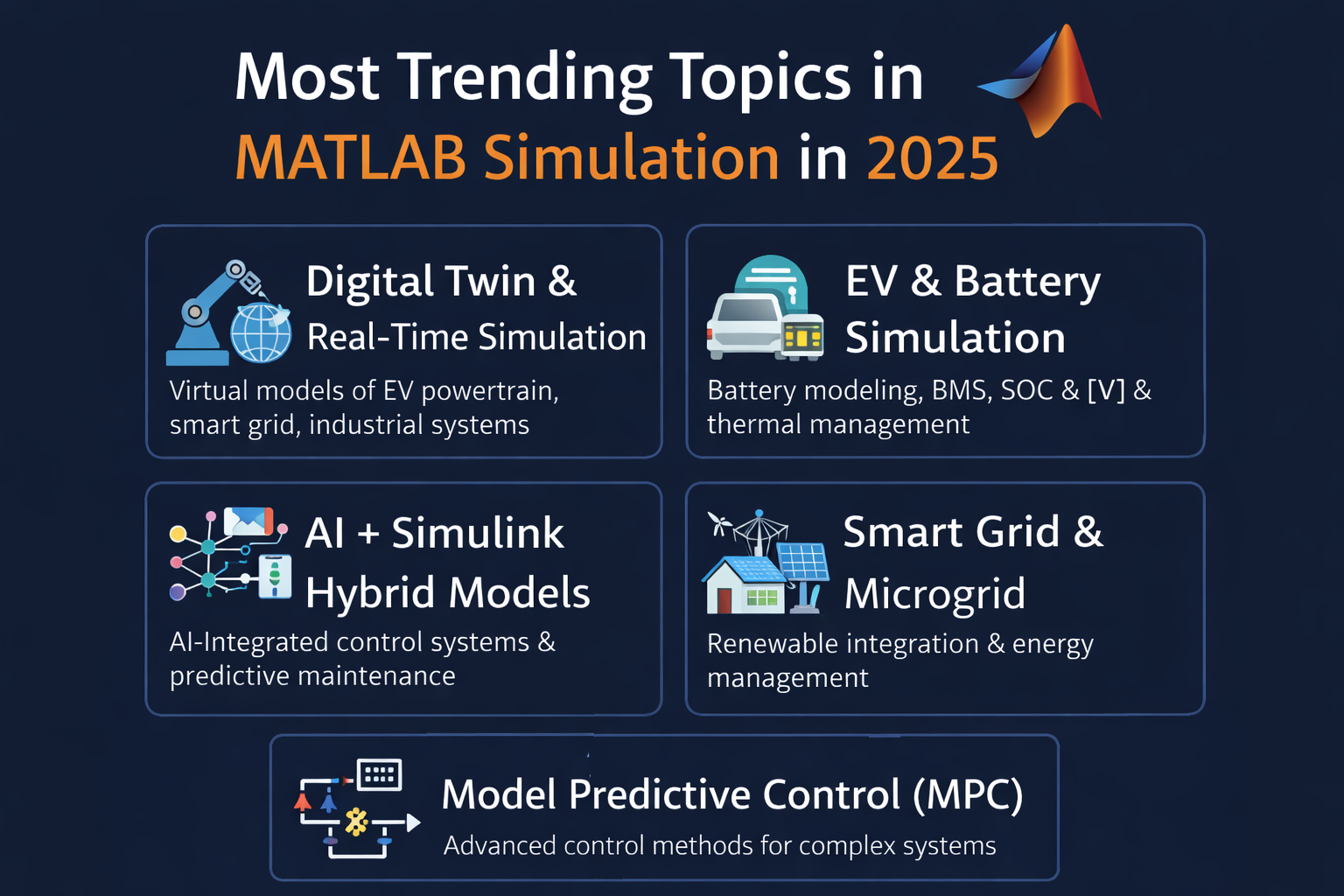
1. Digital Twin Modeling and Real-Time Simulation
Digital Twin technology is one of the fastest-growing areas in engineering simulation. A digital twin is a virtual replica of a physical system that allows engineers to simulate, monitor, and optimize performance in real time.
Using MATLAB Simulink and Simscape, engineers can create digital twins of:
-
Electric vehicle powertrains
-
Smart grids
-
Industrial automation systems
-
Renewable energy plants
Real-time simulation and hardware-in-the-loop (HIL) testing make this field highly valuable for automotive and manufacturing industries.
Why it’s trending:
-
Industry 4.0 adoption
-
Predictive maintenance demand
-
Real-time system optimization
2. Electric Vehicle (EV) and Battery Management System (BMS) Simulation
With the global shift toward electric mobility, EV modeling has become one of the most researched MATLAB applications. Engineers simulate:
-
Battery pack modeling
-
State of Charge (SOC) estimation
-
Thermal behavior of batteries
-
Motor drive systems (PMSM, BLDC)
-
Inverters and DC-DC converters
Battery Management System (BMS) algorithms are especially trending due to safety, efficiency, and lifecycle optimization requirements.
Why it’s trending:
-
EV market growth
-
Government sustainability policies
-
Automotive R&D investments
3. AI and Machine Learning Integration with Simulink
Artificial Intelligence is transforming control systems. MATLAB now supports AI and deep learning integration with Simulink models.
Applications include:
-
Fault detection systems
-
Predictive maintenance
-
Intelligent motor control
-
Smart energy forecasting
-
Adaptive control systems
Combining traditional control methods with AI-based optimization is becoming a major research focus.
Why it’s trending:
-
AI-driven automation
-
Data-based predictive systems
-
Intelligent control design
4. Smart Grid and Microgrid Simulation
Smart grid modeling is gaining importance due to renewable energy integration and demand response strategies.
Common simulation areas include:
-
Microgrid coordination
-
Load scheduling
-
Grid-connected PV systems
-
Energy storage systems
-
Demand-side management
MATLAB Simulink provides detailed tools for modeling grid dynamics and power quality analysis.
Related Verified MATLAB & Simulink Projects
Need pre-built, debugged Simulink models with complete parameter initialization scripts and documentation? Explore top related solutions:
Common Engineering Troubleshooting & Q&A
Frequently encountered bugs, solver convergence issues, and implementation questions answered by our engineering mentors:
Recommended Engineering Articles
Need Custom MATLAB / Simulink Implementation?
Our team of PhD engineers build custom simulation plants, train machine learning agents, tune PID/MPC controllers, and deliver complete, executable code with Turnitin reports.