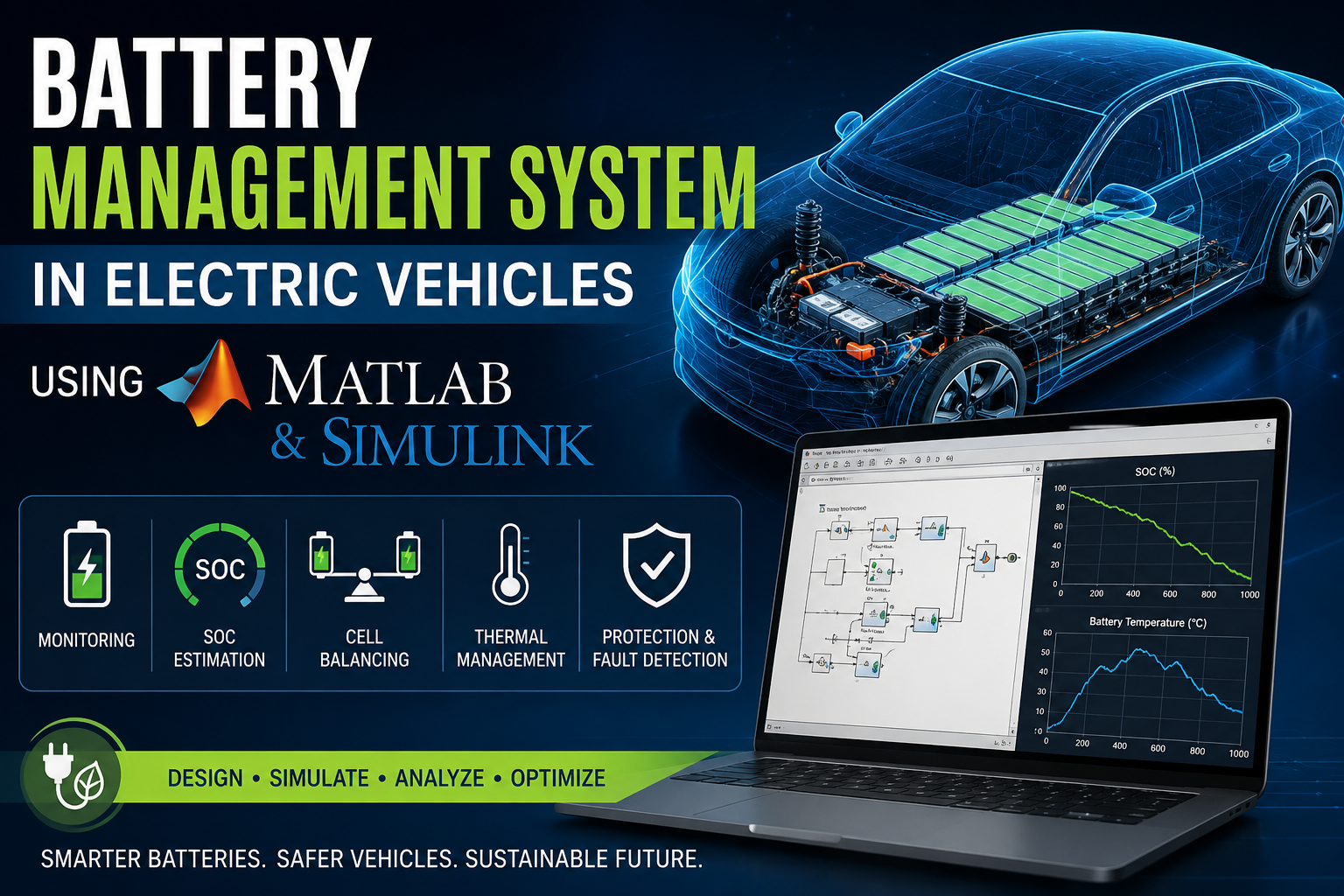
The Battery Management System (BMS) serves as the intelligent brain of an electric vehicle (EV) battery pack. It ensures safety, maximizes performance, extends battery life, and optimizes energy usage in real-world driving conditions. As EVs become mainstream, mastering BMS design is critical for engineers and researchers.
MATLAB and Simulink, with tools like Simscape Battery, provide a powerful Model-Based Design environment for developing, simulating, testing, and deploying BMS algorithms. This blog explores BMS fundamentals, key functions, and practical implementation using MATLAB & Simulink, helping you build impressive, industry-relevant models.
Why BMS Matters in Electric Vehicles.
Lithium-ion batteries power most modern EVs but are sensitive to overcharging, deep discharging, temperature extremes, and cell imbalances. A robust BMS:
- Prevents catastrophic failures like thermal runaway.
- Optimizes range and efficiency through accurate State of Charge (SOC) estimation.
- Extends battery lifespan via cell balancing and thermal management.
- Ensures compliance with safety standards (e.g., ISO 26262 for functional safety).
Without a BMS, even high-quality cells degrade quickly or pose safety risks. In EVs, the BMS communicates via CAN bus with the vehicle controller, charger, and dashboard.
Key Functions of a BMS
A comprehensive BMS performs several interconnected tasks:
- Monitoring: Continuously measures cell voltage, current, temperature, and other parameters.
- Protection: Implements safeguards against over-voltage, under-voltage, over-current, over-temperature, and short circuits. It can disconnect the pack if limits are exceeded.
- State Estimation:
- State of Charge (SOC): Estimates remaining capacity (e.g., using Coulomb counting, Kalman filters, or advanced observers).
- State of Health (SOH): Tracks degradation over cycles for predictive maintenance.
- Cell Balancing: Equalizes charge levels across cells (passive via resistors or active via energy transfer) to prevent weak cells from limiting the entire pack.
- Thermal Management: Controls cooling/heating systems to maintain optimal temperature ranges (typically 15–35°C for Li-ion cells).
- Fault Diagnosis and Communication: Detects insulation faults, predicts issues, and interfaces with other vehicle systems.
These functions require sophisticated algorithms that are best developed and validated through simulation before hardware deployment.
Modeling BMS in MATLAB & Simulink: Step-by-Step Approach.
MathWorks tools excel here by enabling closed-loop simulation of the entire battery system alongside control algorithms.
1. Battery Pack Modeling with Simscape Battery
- Use the Battery Builder app or MATLAB API to create detailed pack models from individual cell data.
- Model different fidelities: Equivalent Circuit Models (ECM) for fast simulation, or electrochemical models for higher accuracy.
- Incorporate thermal effects, aging (fade), and SOC/temperature-dependent parameters.
- Simulate realistic scenarios: driving cycles (e.g., WLTP, UDDS), fast charging, and environmental variations.
2. Developing BMS Control Algorithms
- Use Simulink blocks and Stateflow for supervisory logic, protection, and balancing strategies.
- Built-in BMS blocks in Simscape Battery handle SOC/SOH estimation, balancing, and protection.
- Implement advanced estimators:
- Extended Kalman Filter (EKF) or Unscented Kalman Filter (UKF) for accurate SOC.
- Machine learning models (via MATLAB) for SOH prediction.
- Model power electronics: contactors, DC-DC converters, and sensors.
3. Simulation and Testing Workflow
- Desktop Simulation: Closed-loop testing of BMS algorithms with the plant (battery pack) model.
- Software-in-the-Loop (SIL) and Processor-in-the-Loop (PIL): Verify generated C/C++ code.
- Hardware-in-the-Loop (HIL): Integrate with real BMS hardware for real-time validation.
- Use Simulink Test for requirements-based testing and coverage analysis.
Example: Simple BMS Model in Simulink
A typical model includes:
- Battery pack subsystem (series/parallel cells).
- Voltage/Current/Temperature sensors.
- SOC estimator block.
- Protection logic (if-then rules or Stateflow charts).
- Cell balancing circuit.
- Thermal model with cooling system.
You can start with MathWorks examples or open-source models like MiniBMS on GitHub, then scale up.
Researchers have published Simulink-based BMS simulations demonstrating SOC estimation accuracy, protection under fault conditions, and balancing performance.
Advanced Topics and Best Practices
- Multi-Physics Simulation: Couple electrical, thermal, and mechanical domains in Simscape.
- Optimization: Use MATLAB to tune parameters for balancing algorithms or thermal controllers.
- Code Generation: Automatically generate production-ready C code or HDL for embedded controllers (e.g., microcontrollers or FPGAs).
- Digital Twins: Create virtual replicas for predictive maintenance and fleet monitoring.
- Integration with Full Vehicle Model: Simulate the BMS within a complete EV powertrain (motor, inverter, etc.) for system-level optimization.
Tips for Impressive Results:
- Validate models against real cell datasheet and test data.
- Perform sensitivity analysis on parameters like temperature and aging.
- Document requirements and use formal methods for safety-critical aspects.
- Explore MathWorks webinars and whitepapers for ready-to-use workflows.
Benefits of Using MATLAB & Simulink for BMS Development
- Accelerated Development: Iterate designs rapidly without physical prototypes.
- Reduced Costs and Risks: Catch issues early through simulation.
- Scalability: From single-cell to full vehicle packs, including 2/3-wheelers.
- Industry Adoption: Widely used by automotive OEMs and suppliers for production BMS software.
- Future-Proofing: Support for emerging technologies like solid-state batteries or advanced AI-based estimators.
Engineers report significant time savings and higher confidence in designs when using Model-Based Design.
Conclusion: Powering the Future of EVs
A well-designed BMS is essential for safe, efficient, and long-lasting EV batteries. MATLAB and Simulink empower you to master this complexity from conceptual modeling to deployment enabling innovation in one of the most critical EV technologies.
Whether you're a student, researcher, or automotive engineer, start experimenting with Simscape Battery examples today. Build a simple SOC estimator or full protection system, simulate real-world scenarios, and visualize results. The skills you gain will undoubtedly impress in projects, theses, or job interviews.
Ready to dive in? Check MathWorks documentation, download trial models, or explore their BMS-focused videos and whitepapers. The road to better EVs starts with better BMS design!
Related Verified MATLAB & Simulink Projects
Need pre-built, debugged Simulink models with complete parameter initialization scripts and documentation? Explore top related solutions:
Common Engineering Troubleshooting & Q&A
Frequently encountered bugs, solver convergence issues, and implementation questions answered by our engineering mentors:
Recommended Engineering Articles
Need Custom MATLAB / Simulink Implementation?
Our team of PhD engineers build custom simulation plants, train machine learning agents, tune PID/MPC controllers, and deliver complete, executable code with Turnitin reports.