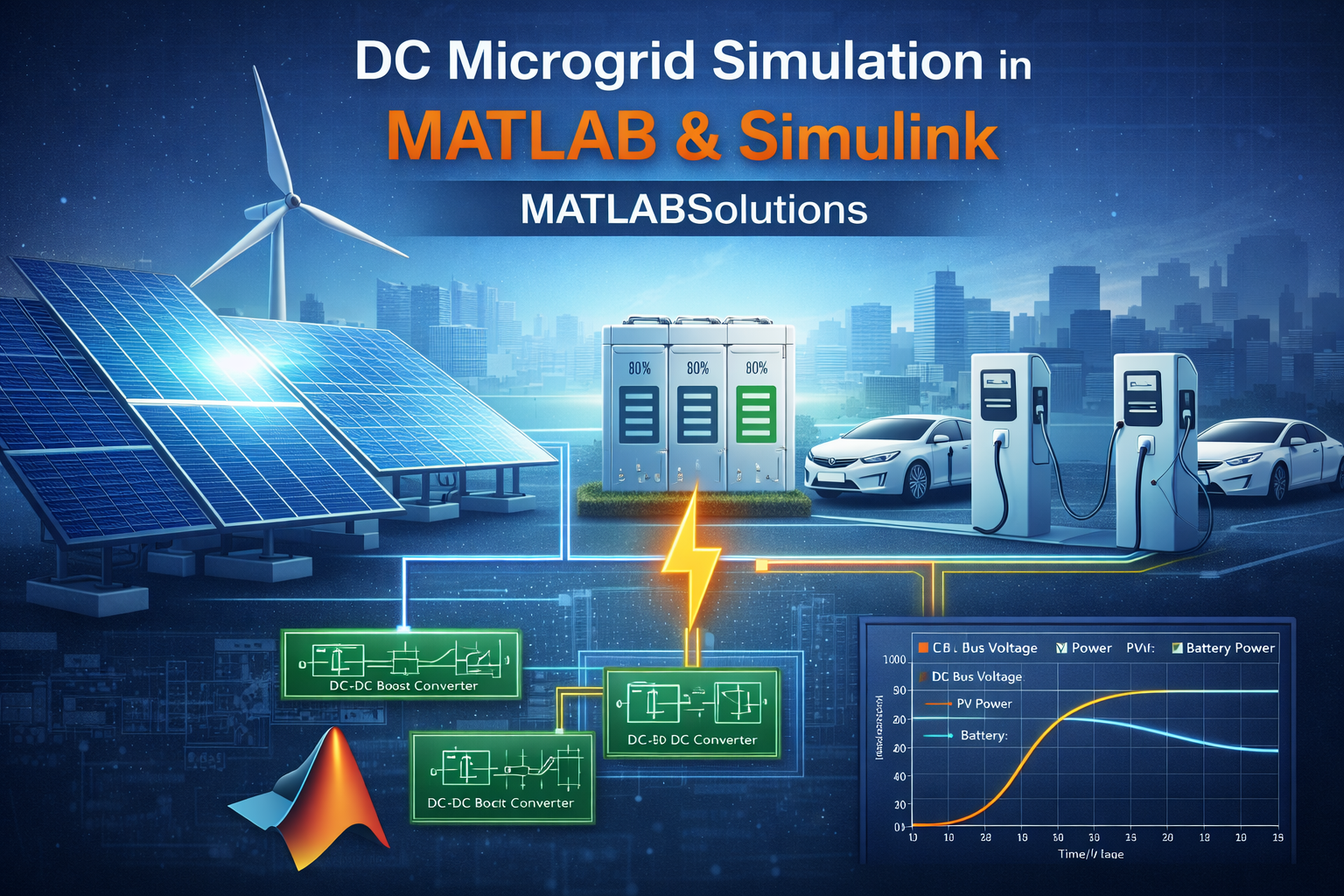
What is Microgrid Simulation Using MATLAB Simulink?
Microgrid Simulation Using MATLAB Simulink is a MATLAB-based technical project and simulation model. Direct Current (DC) microgrids provide substantial efficiency and reliability advantages for electric vehicle charging infrastructure, cloud data centers, residential solar installations, and remote off-grid communities. By operating on a common DC distribution bus, these systems eliminate AC-DC-AC conversion stages, bypass reactive power losses, and remove the need for complex grid frequency synchronization. However, managing a multi-source DC microgrid requires coordinated power sharing and fast voltage regulation to counteract sudden solar intermittency and prevent instability caused by Constant Power Loads (CPLs). In MATLAB and Simulink, using Simscape Electrical allows power systems engineers to model solar PV arrays, bidirectional battery converters, supercapacitors, and interlinking converters connected to an AC utility grid. This project covers the architectural design, DC-DC converter modeling, decentralized voltage droop control, and dynamic stability simulation of a hybrid DC microgrid in MATLAB.
Project Methodology
The design, control implementation, and dynamic simulation of a multi-source DC microgrid in MATLAB Simulink follows a structured power systems and power electronics workflow:
- System Architecture & DC Bus Sizing: Define the microgrid layout in Simscape Electrical around a common 380V DC distribution bus, sizing generation capacities for a Solar PV array, a Lithium-Ion battery storage unit, an auxiliary supercapacitor bank, and localized DC loads.
- Solar PV & DC-DC Boost MPPT Modeling: Model the solar PV module characteristics and design a high-frequency DC-DC boost converter governed by a Perturb and Observe (P&O) Maximum Power Point Tracking (MPPT) algorithm to harvest peak solar energy under fluctuating solar irradiance.
- Battery Energy Storage & Bidirectional Converter: Configure a Lithium-Ion battery pack with dynamic equivalent circuit modeling and integrate a bidirectional DC-DC buck-boost converter. Implement dual-loop PI control (inner inductor current and outer capacitor voltage) to regulate battery charging and discharging.
- Decentralized Voltage Droop Control (Primary Layer): Formulate P-V droop control logic (
V_dc_ref = V_nom - R_droop × I_out) for each distributed converter, enabling autonomous load current sharing proportional to source capacity without requiring communication cables. - Secondary Voltage Restoration & Energy Management: Program a secondary control loop in Simulink to eliminate steady-state voltage offsets caused by primary droop resistance. Implement state-machine logic in Stateflow to manage power routing across grid-connected, battery-supported, and islanded operating regimes.
- Dynamic Disturbance & Constant Power Load (CPL) Testing: Simulate challenging operational conditions in MATLAB Simulink:
- Sudden step drops in solar irradiance (1000 W/m² → 400 W/m²).
- Step additions of non-linear Constant Power Loads (CPL) to verify small-signal stability against negative incremental impedance.
- Seamless islanding transitions from the AC utility grid interlinking converter.
- Waveform Analysis & Bus Stability Validation: Monitor DC bus voltage regulation within ±2% of nominal 380V, evaluate source current-sharing accuracy, track battery State-of-Charge (SoC) boundaries, and compute voltage ripple using the MATLAB Powergui tool.
Verified MATLAB Simulation Code Demonstration
Syntax-highlighted executable code demonstration for Microgrid Simulation Using MATLAB Simulink:
% State-Space Control & Stability Analysis
clc; clear; close all;

% System Matrices
A = [0 1; -4 -5];
B = [0; 1];
C = [1 0];
D = 0;

sys_ss = ss(A, B, C, D);
Co = ctrb(A, B);

% Pole Placement Control
desired_poles = [-3 + 4i, -3 - 4i];
K = acker(A, B, desired_poles);

sys_cl = ss(A - B*K, B, C, D);
fprintf('State Feedback Controller Formulated Successfully!\n');