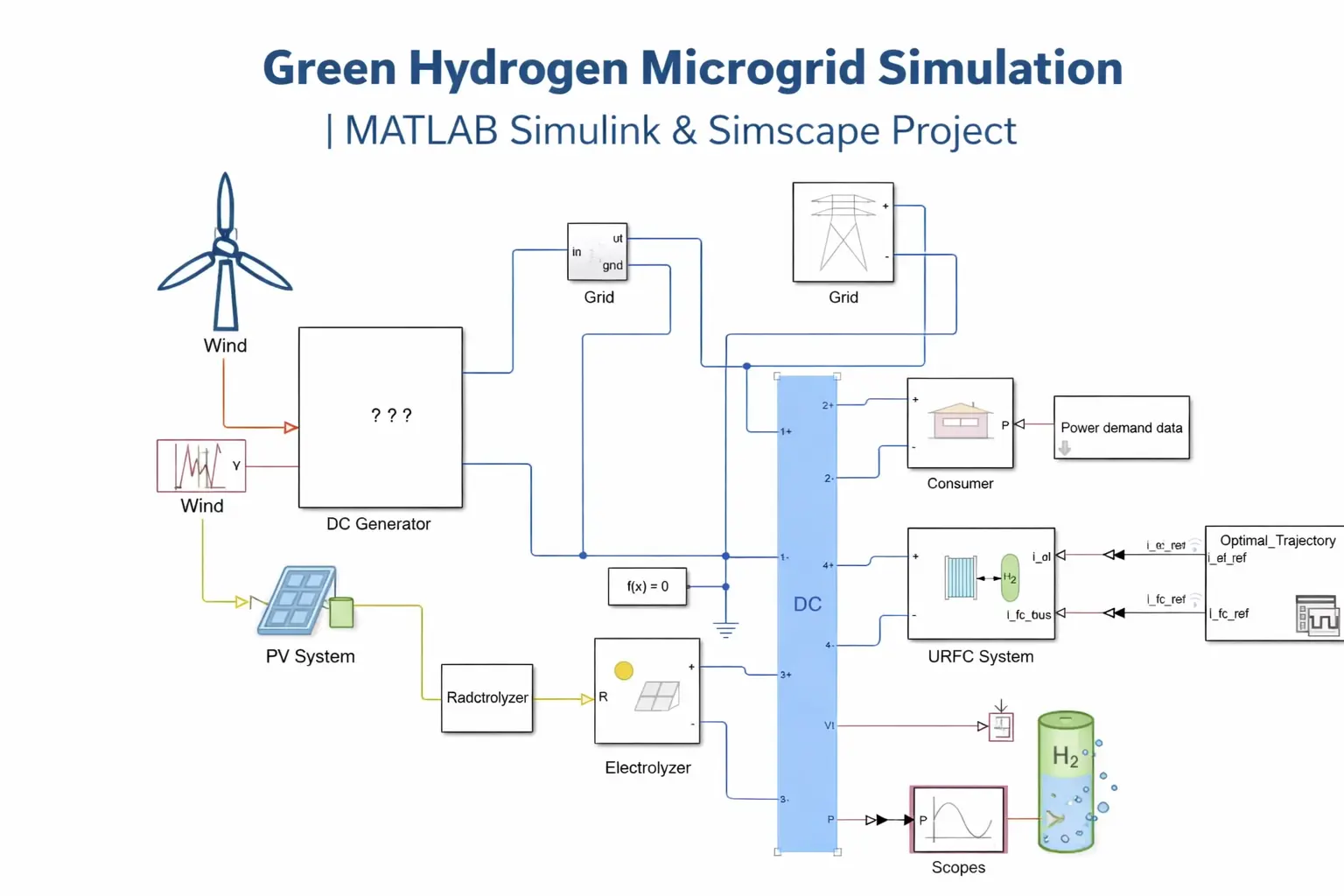
What is Green Hydrogen Microgrid Simulation in MATLAB Simulink?
Green Hydrogen Microgrid Simulation in MATLAB Simulink is a MATLAB-based technical project and simulation model. Green hydrogen, produced through water electrolysis powered by renewable energy, is a critical enabler of the global energy transition. It supports decarbonization of hard-to-abate sectors such as heavy industry, long-distance transport, and long-duration energy storage. In renewable microgrids, green hydrogen functions as a long-term energy buffer by converting surplus solar PV or wind power into hydrogen, reducing curtailment, improving resilience, and enhancing energy autonomy in islanded or weak-grid systems. This project presents a MATLAB/Simulink-based simulation framework for a green hydrogen microgrid incorporating solar PV (or hybrid PV-wind), battery energy storage, PEM or alkaline electrolyzer, hydrogen storage tank, and an optional fuel cell. Using Simscape Electrical, Fluids, and Thermal libraries, the model evaluates multi-day operation under realistic weather conditions. Key outputs include hydrogen production (kg/day), electrolyzer efficiency, battery SoC dynamics, renewable utilization, curtailment reduction, and levelized cost of hydrogen (LCOH), supporting techno-economic analysis, control strategy validation, and scalable microgrid design.
Project Methodology
Green Hydrogen Microgrid Simulation (MATLAB/Simulink)
-
Multi-Physics Simulation Framework
MATLAB/Simulink (R2024b+) with Simscape Electrical, Fluids, and Thermal libraries for system-level microgrid modeling. -
Renewable Energy Generation Modeling
PV array (optional wind) with MPPT control (P&O / Incremental Conductance) using real or synthetic weather data. -
DC Microgrid & Energy Storage System
Lithium-ion battery with SoC estimation, bidirectional DC-DC converter, and 400–800 V common DC bus. -
Electrolyzer System Modeling
PEM or alkaline electrolyzer with V–I characteristics, 60–80% efficiency, Faraday-based hydrogen production, and thermal management. -
Hydrogen Storage & Fuel Cell Integration
Compressed hydrogen tank with pressure–temperature dynamics; optional PEM fuel cell for re-electrification. -
Energy Management & Control Strategy
Rule-based EMS prioritizing battery charging, hydrogen production, and curtailment minimization using Stateflow. -
Simulation Scenarios & Solver Setup
Time-domain simulations (ode23t) using load profiles and long-term weather data. -
Performance Metrics & Validation
Hydrogen yield, system efficiency, curtailment, utilization factor, and benchmark validation.
Verified MATLAB Simulation Code Demonstration
Syntax-highlighted executable code demonstration for Green Hydrogen Microgrid Simulation in MATLAB Simulink:
% Dynamic Physical Model & Solver Configuration
clc; clear; close all;

% Hydraulic & Mechanical ODE System Parameters
m = 1.0; c = 0.5; k = 9.0;
ode_sys = @(t, y) [y(2); -(c/m)*y(2) - (k/m)*y(1)];

% Numerical ODE Integration
tspan = [0 10]; y0 = [1.0; 0.0];
[t, y] = ode45(ode_sys, tspan, y0);

fprintf('ODE Physical System Solved across %d Time Steps!\n', length(t));