What is Three-Phase PMSM Drive Modeling in MATLAB Simulink for Hybrid Electric Vehicles?
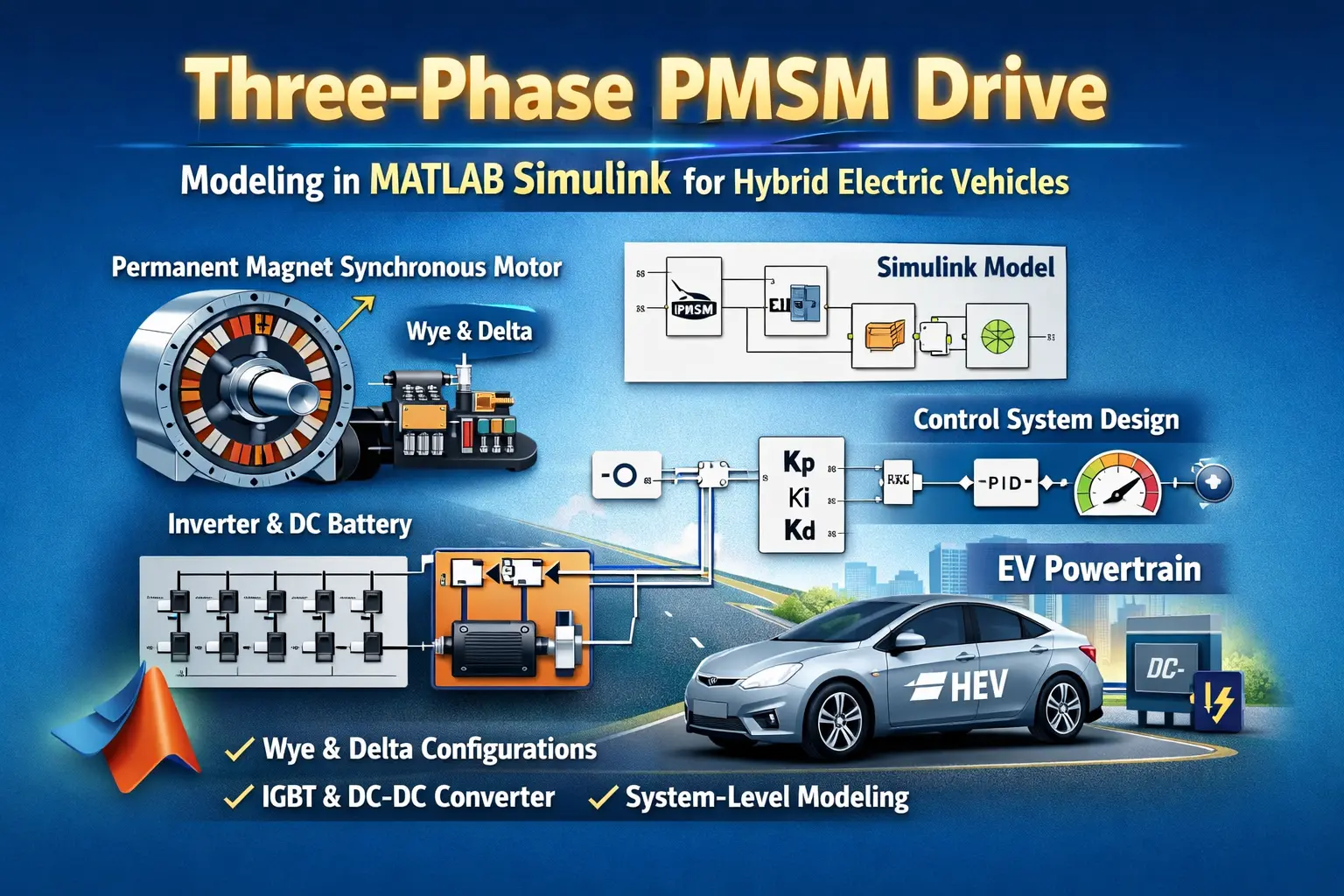
Three-Phase PMSM Drive Modeling in MATLAB Simulink for Hybrid Electric Vehicles is a MATLAB-based technical project and simulation model. The Three-Phase Permanent Magnet Synchronous Motor (PMSM) Drive is widely used in Hybrid Electric Vehicles (HEVs) due to its high efficiency, high power density, and excellent torque characteristics. Accurate modeling and simulation of the PMSM drive system are essential for designing reliable and energy-efficient electric powertrains. This project focuses on the modeling of a three-phase PMSM drive in MATLAB Simulink, including wye-wound and delta-wound motor configurations powered by a three-phase inverter connected to a vehicle battery. The model enables detailed analysis of motor performance, inverter switching behavior, and controller design for hybrid electric vehicle applications.
Project Methodology
The methodology adopted for modeling the Three-Phase PMSM Drive in MATLAB Simulink is summarized as follows:
-
PMSM Modeling
A three-phase PMSM model is developed using Simulink blocks, supporting both wye and delta connections to analyze different operating characteristics. -
Inverter Design
A three-phase voltage source inverter (VSI) is implemented using IGBT devices, directly connected to the vehicle battery. For detailed switching analysis, standard IGBTs can be replaced with N-Channel IGBT blocks. -
Control System Design
A PMSM control architecture is selected and tuned by adjusting controller gains to achieve desired speed and torque performance. -
Power Source Integration
The inverter is supplied by a DC battery source. An optional DC-DC converter stage can be added to regulate the DC-link voltage. -
System-Level Abstraction
For complete vehicle modeling, the Motor & Drive (System Level) block is used to abstract the PMSM, inverter, and controller into an energy-based model, improving simulation speed. -
Numerical Stability Enhancement
A Gmin resistor is included to provide a small conductance to ground, improving numerical stability when using a variable-step solver.
Verified MATLAB Simulation Code Demonstration
Syntax-highlighted executable code demonstration for Three-Phase PMSM Drive Modeling in MATLAB Simulink for Hybrid Electric Vehicles:
% State-Space Control & Stability Analysis
clc; clear; close all;

% System Matrices
A = [0 1; -4 -5];
B = [0; 1];
C = [1 0];
D = 0;

sys_ss = ss(A, B, C, D);
Co = ctrb(A, B);

% Pole Placement Control
desired_poles = [-3 + 4i, -3 - 4i];
K = acker(A, B, desired_poles);

sys_cl = ss(A - B*K, B, C, D);
fprintf('State Feedback Controller Formulated Successfully!\n');