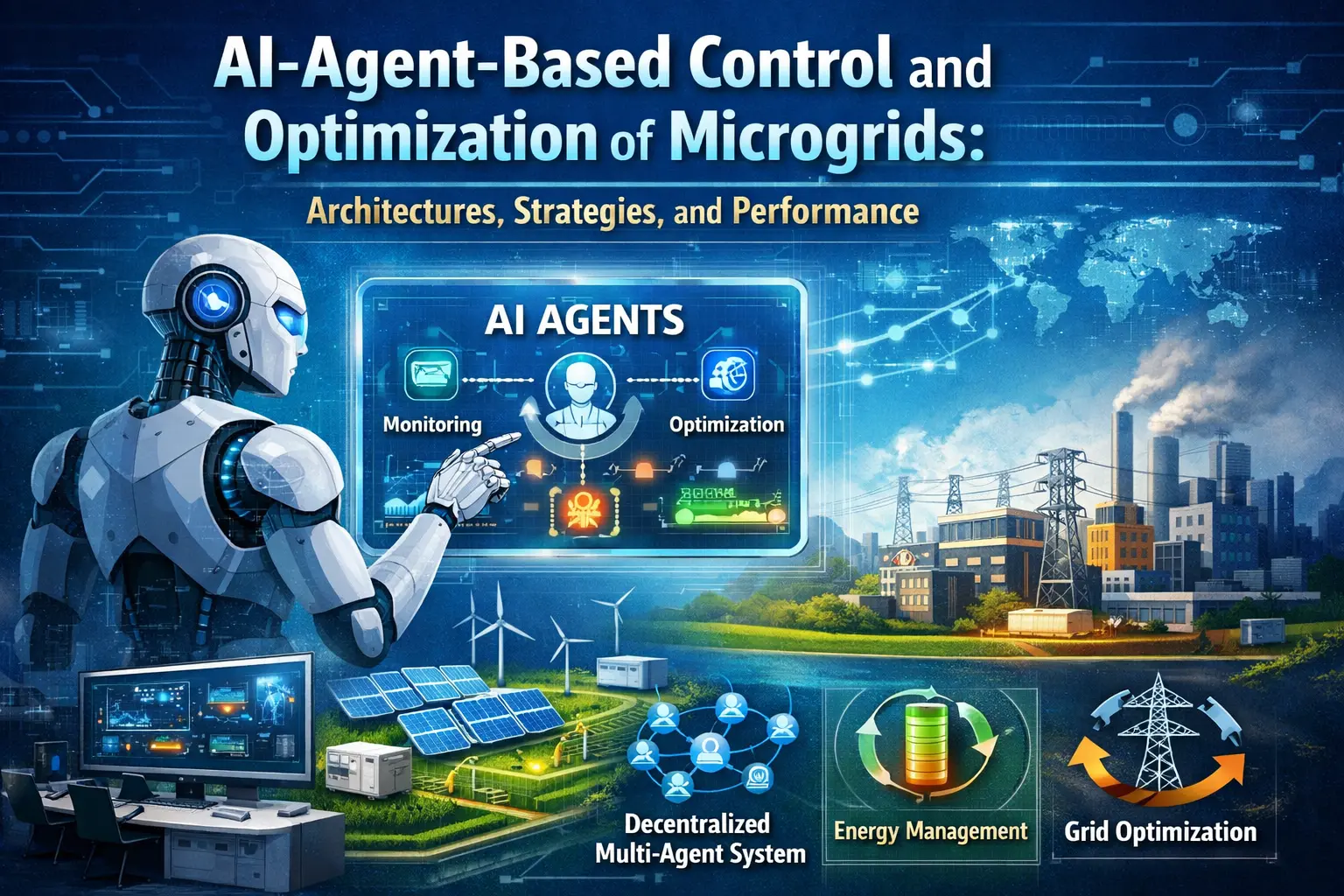
In the era of renewable energy transition, microgrids are becoming essential for reliable, efficient, and resilient power distribution — especially in remote areas, industrial sites, campuses, and urban setups with high renewable penetration. Traditional rule-based or classical control methods often struggle with uncertainties like variable solar/wind generation, dynamic loads, and real-time pricing.
This is where AI-Agent-Based Control shines. Autonomous AI agents — powered by reinforcement learning (RL), multi-agent systems (MAS), or deep learning — can sense the environment, make decisions, coordinate actions, and optimize objectives like cost minimization, voltage/frequency stability, and renewable utilization.
In this blog, we explore how to implement AI-agent-based microgrid control and optimization using MATLAB and Simulink, with practical insights, architectures, strategies, and performance tips. Whether you're a student working on your final-year project or an engineer designing real-world systems, MATLAB's toolboxes make it accessible and powerful.
Why AI Agents for Microgrid Control?
Microgrids involve multiple distributed energy resources (DERs): PV panels, wind turbines, batteries, diesel generators, fuel cells, and loads. Coordinating them in grid-connected or islanded modes requires intelligent decision-making under uncertainty.
Key Benefits of AI-Agent-Based Approaches:
- Autonomous Operation — Agents learn optimal policies without explicit programming.
- Multi-Agent Coordination — Handle conflicting goals (e.g., battery SoC preservation vs. peak shaving).
- Adaptability — Handle stochastic renewables and load variations better than PID or MPC in complex scenarios.
- Real-Time Optimization — Minimize operational cost, emissions, or maximize reliability.
Common AI techniques include:
- Reinforcement Learning (DQN, PPO, Multi-Agent RL)
- Deep Reinforcement Learning (using Reinforcement Learning Toolbox)
- Multi-Agent Systems (cooperative/competitive agents)
Common Architectures for AI-Agent-Based Microgrid Control
- Centralized AI Agent A single agent oversees the entire microgrid (e.g., energy management system — EMS). It uses global state information for optimal dispatch.
- Distributed Multi-Agent Framework Each DER or component (battery, PV inverter, load) has its own agent. Agents communicate or negotiate for consensus (ideal for scalability and fault tolerance).
- Hierarchical Agent Structure
- Primary level: Local droop control
- Secondary level: AI agents for frequency/voltage restoration
- Tertiary level: Economic optimization via RL agents
MATLAB excels here — model the physical layer in Simscape Electrical, control logic in Simulink, and train AI agents using Reinforcement Learning Toolbox or Deep Learning Toolbox.
Strategies and Implementation in MATLAB
Step-by-Step Workflow in MATLAB:
-
Model the Microgrid Use Simscape Electrical to build PV, wind, battery, grid, and loads. Start with examples like "Microgrid with Battery Storage" or "Remote Microgrid Design".
→ Check our detailed guide: Microgrid Simulation with Battery Storage System Using MATLAB
-
Define the Environment for RL Agents Create a custom RL environment (observation: SoC, power imbalance, price; actions: charge/discharge rate, dispatch setpoints; reward: -cost + stability bonus).
-
Train AI Agents
- Use rlDQNAgent or rlPPOAgent for single-agent EMS.
- For multi-agent: Leverage Multi-Agent Reinforcement Learning concepts.
- Simulate episodes in Simulink for training.
-
Optimize Performance Compare against classical methods (e.g., rule-based EMS or linear programming). Evaluate KPIs: Cost savings (%), renewable curtailment reduction, voltage deviation, payback period.
-
Deploy & Validate Export trained policies to C/C++ or HDL for embedded controllers, or run Hardware-in-the-Loop (HIL) tests.
Real-World Performance Insights (from recent implementations):
- RL agents can reduce energy costs by 15–30% compared to rule-based controllers.
- Multi-agent setups improve resilience during islanding transitions.
- Integration with predictive forecasting (e.g., load/PV using neural nets) boosts results further.
Ready-to-Use Resources & Examples
We have helped hundreds of students and researchers implement similar systems. Some popular related projects on our site:
- Smart Grid Simulation in MATLAB: Models & Examples — Foundational smart grid models to extend to AI agents.
- PID Tuning Using Genetic Algorithm & PSO in Microgrid MATLAB Simulink — Compare classical vs. AI optimization.
- Green Hydrogen Microgrid Simulation in MATLAB — Extend to AI-optimized hydrogen production.
- Grid-Connected PV-Diesel-Battery with Fuzzy Logic EMS — Upgrade to RL agents.
Need custom code, Simulink models, or full project implementation for AI-Agent-Based Microgrid Control? Our experts deliver ready-to-submit solutions with documentation, results, and explanations.
Conclusion: Future of Intelligent Microgrids with MATLAB
AI-agent-based control is transforming microgrids from passive systems to proactive, intelligent networks. With MATLAB's integrated environment — from modeling in Simulink/Simscape to training agents in RL Toolbox — you can prototype, optimize, and validate faster than ever.
Ready to build your own AI-powered microgrid controller? Submit your assignment or contact us for a free consultation today. Let's optimize your energy future!
Related Verified MATLAB & Simulink Projects
Need pre-built, debugged Simulink models with complete parameter initialization scripts and documentation? Explore top related solutions:
Common Engineering Troubleshooting & Q&A
Frequently encountered bugs, solver convergence issues, and implementation questions answered by our engineering mentors:
Recommended Engineering Articles
Need Custom MATLAB / Simulink Implementation?
Our team of PhD engineers build custom simulation plants, train machine learning agents, tune PID/MPC controllers, and deliver complete, executable code with Turnitin reports.