What is Bidirectional DAB Converter with CC-CV Battery Charging Control in MATLAB Simulink?
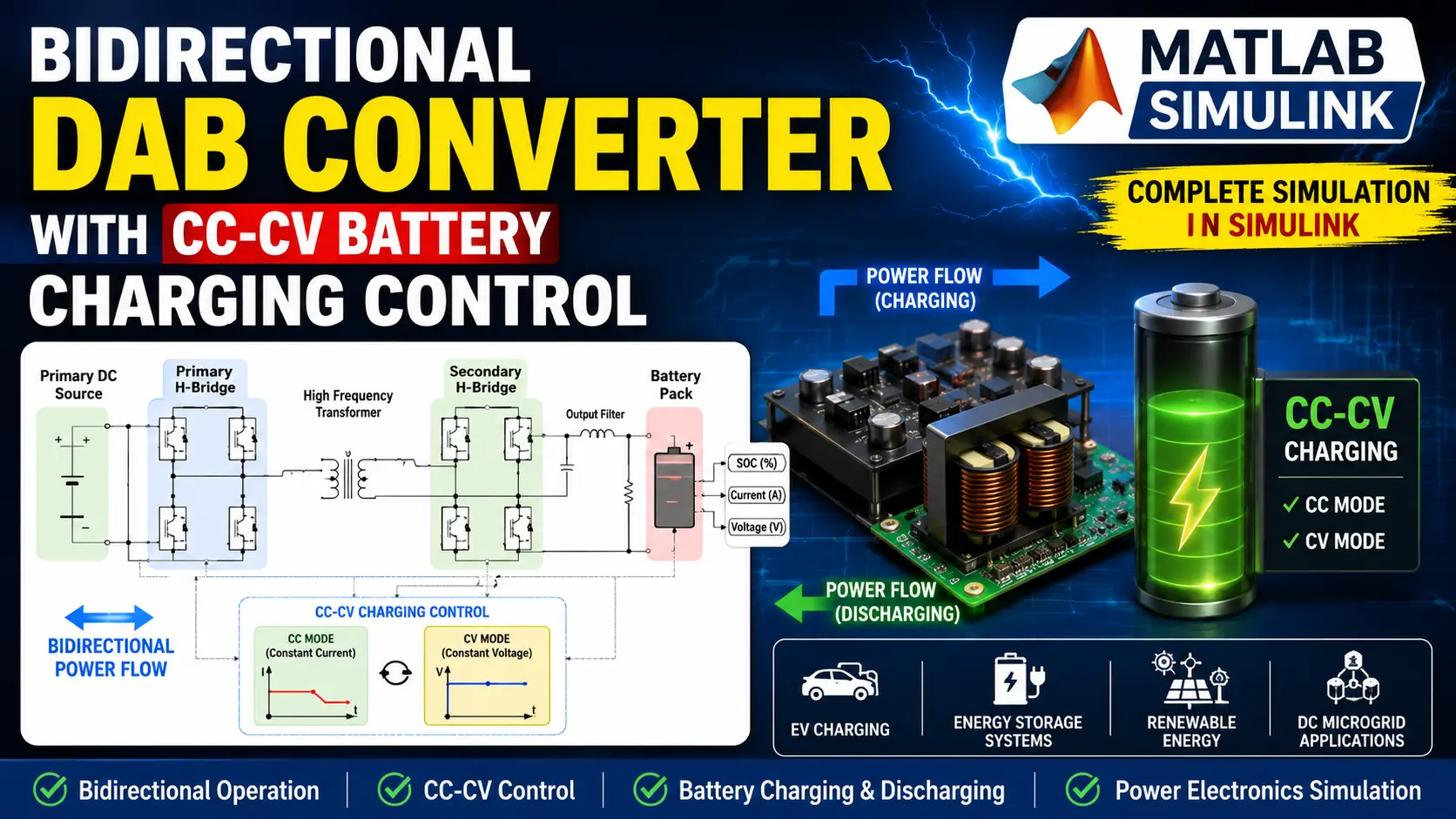
Bidirectional DAB Converter with CC-CV Battery Charging Control in MATLAB Simulink is a MATLAB-based technical project and simulation model. The Bidirectional Dual Active Bridge (DAB) Converter with CC-CV Battery Charging Control is a powerful isolated DC-DC conversion topology designed for applications such as electric vehicle (EV) charging, battery energy storage systems (BESS), DC microgrids, and renewable energy systems. The DAB converter enables bidirectional power flow between the DC source and battery, allowing both battery charging and discharging. In this MATLAB Simulink model, the DAB converter uses high-frequency transformer isolation and controlled switching bridges to transfer power between the two DC sides. A Constant Current–Constant Voltage (CC-CV) charging strategy is implemented to provide controlled battery charging. During the CC stage, the battery is charged with a regulated current, while during the CV stage, the battery voltage is maintained at the specified reference as the charging current gradually decreases.
Project Methodology
The simulation methodology consists of the following major stages:
- DC Source and Primary H-Bridge
A DC input is connected to the primary-side full-bridge inverter. Controlled switching devices generate a high-frequency AC waveform for power transfer through the transformer. - High-Frequency Transformer
The transformer provides galvanic isolation and transfers energy between the primary and secondary sides of the DAB converter. - Secondary H-Bridge
A controlled secondary full bridge converts the high-frequency transformer output back into a DC voltage. The phase relationship between the two bridges controls the direction and magnitude of power transfer. - Bidirectional Power Flow Control
By changing the phase shift between the primary and secondary bridge switching signals, power can flow either:- DC source → battery for charging
- Battery → DC source for discharging
- CC-CV Battery Charging Control
The battery charging process is divided into two operating modes:- Constant Current (CC): The converter regulates the battery charging current to a predefined reference.
- Constant Voltage (CV): Once the battery reaches the voltage threshold, the controller maintains the battery voltage while allowing the charging current to decrease.
- Battery Model and Feedback Signals
Battery voltage, current, and SOC are monitored and fed back to the control system. These measurements are used to determine the appropriate charging mode and regulate converter operation. - Simulation and Performance Analysis
MATLAB Simulink is used to evaluate the converter's transient response, charging characteristics, power flow, battery voltage, current, and SOC throughout the simulation.
Verified MATLAB Simulation Code Demonstration
Syntax-highlighted executable code demonstration for Bidirectional DAB Converter with CC-CV Battery Charging Control in MATLAB Simulink:
% State-Space Control & Stability Analysis
clc; clear; close all;

% System Matrices
A = [0 1; -4 -5];
B = [0; 1];
C = [1 0];
D = 0;

sys_ss = ss(A, B, C, D);
Co = ctrb(A, B);

% Pole Placement Control
desired_poles = [-3 + 4i, -3 - 4i];
K = acker(A, B, desired_poles);

sys_cl = ss(A - B*K, B, C, D);
fprintf('State Feedback Controller Formulated Successfully!\n');