Question
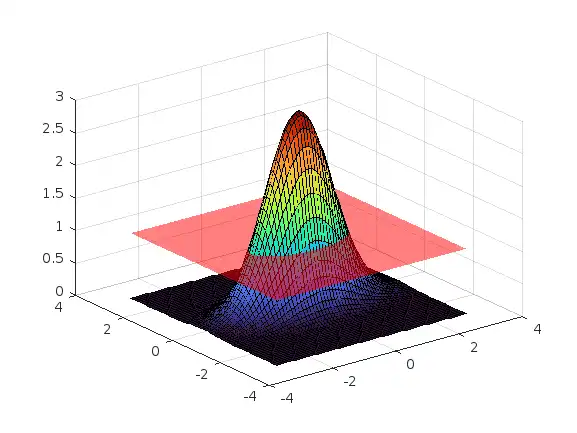
I have a bell shaped curve in 3D (generated from curve fitter app) as shown in the figures. Both are the same curve the only difference is one is without point data and the other has point data. Problem: I want to add another surface to the same plot for the same data which is at z=1 and parallel to x- and y-axis. Also, is it possible to find the values of major and minor axes of the ellipse formed from the intersection of both the surfaces. Or in other words, the values between the intersection of x and z values of both the curves and the y and z values of both the curves. I hope I am able to express myself clearly.
Expert Answer

Prashant Kumar
PhD Expert
Answered Oct 15, 2026
Try this —
‘I want to add another surface to the same plot for the same data which is at z=1 and parallel to x- and y-axis.’
[X,Y] = ndgrid(-3:0.1:3);
f  = @(x,y) exp(-(x.^2+(2*y).^2)*0.5);
Z = f(X,Y)*3;

figure
surf(X, Y, Z)
hold on
surf(X, Y, ones(size(Z)), 'FaceColor','r', 'FaceAlpha',0.5, 'EdgeColor','none')
hold off
colormap(turbo)
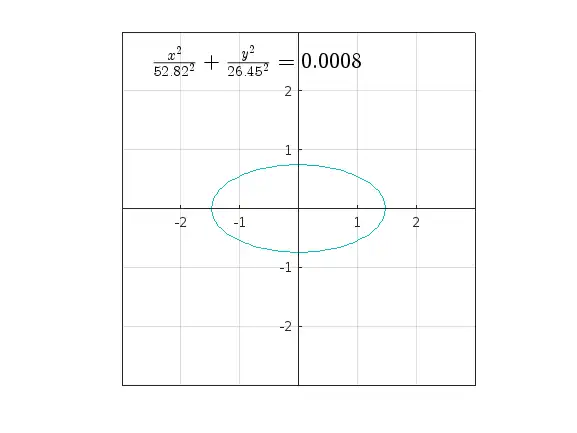
‘Also, is it possible to find the values of major and minor axes of the ellipse formed from the intersection of both the surfaces.’
figure
[c,h] = contour(X, Y, Z, [1 1]);
axis('equal')
grid
Ax = gca;
Ax.XAxisLocation = 'origin';
Ax.YAxisLocation = 'origin';
elpsfcn = @(b,xy) xy(1,:).^2/b(1)^2 + xy(2,:).^2/b(2)^2 - b(3);
opts = optimoptions('fminunc', 'MaxFunctionEvaluations', 5E+3, 'MaxIterations',1E+4);
[B, fv] = fminunc(@(b) norm(elpsfcn(b,c(:,2:end))), rand(3,1), opts)
Local minimum possible.

fminunc stopped because it cannot decrease the objective function
along the current search direction.
B = 3×1
   52.8204
   26.4510
    0.0008
fv = 1.2653e-05
fprintf('Semimajor Axis = %.4f\nSemiminor Axis = %.4f\nConstant = %.4f\n', B)
Semimajor Axis = 52.8204
Semiminor Axis = 26.4510
Constant       = 0.0008
text(-2.5, 2.5, sprintf('$\\frac{x^2}{%.2f^2} + \\frac{y^2}{%.2f^2} = %.4f$',B), 'Interpreter','latex', 'FontSize',16)
100% Run Guarantee
3-Hour Fast-Track Delivery
Need a Custom Version or Complete Simulation for This Problem?
Our 500+ PhD engineers build, debug, and optimize working MATLAB scripts and Simulink (.slx) models tailored to your exact assignment rubrics with zero plagiarism.
Tested on MATLAB R2024b / R2026a
Turnitin 0% Plagiarism Report
Free 7-Day Revisions Guarantee
Have a different question? Ask here
Related gauss Questions & Solutions
Browse All →
Explore similar technical troubleshooting questions and verified MATLAB solutions:
Ready-to-Run MATLAB & Simulink Projects
Browse All Projects →