Question
Hello, How can I generate a uniformly distributed random vector with its sum to be equal to 1?
Expert Answer

Prashant Kumar
PhD Expert
Answered Oct 15, 2026
Too many people think that generating a uniform sample, then normalizing by the sum will generate a uniform sample. In fact, this is NOT at all true.
A good way to visualize this is to generate that sample for the 2-d case. For example, suppose we do it the wrong way first?
xy = rand(100,2);
plot(xy(:,1),xy(:,2),'.')
Now, lets do the sum projection that virtually everyone poses. (Yes, it is the obvious choice. Now we will see why it is the wrong approach.)
xys = bsxfun(@rdivide,xy,sum(xy,2));
hold on
plot(xys(:,1),xys(:,2),'ro')
axis equal
axis square
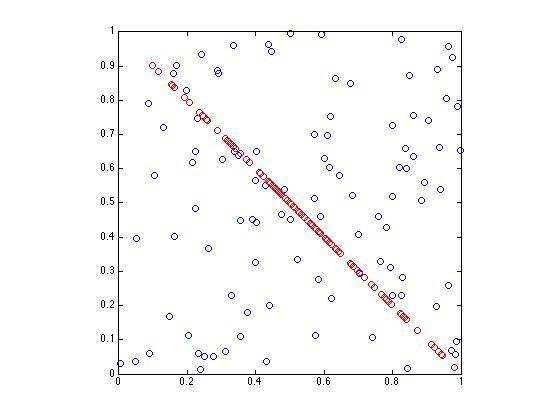
The sum-projected points lie along the diagonal line. Note the distribution seems to be biased towards the middle of the line. A uniform sample would have points uniformly distributed along that line.
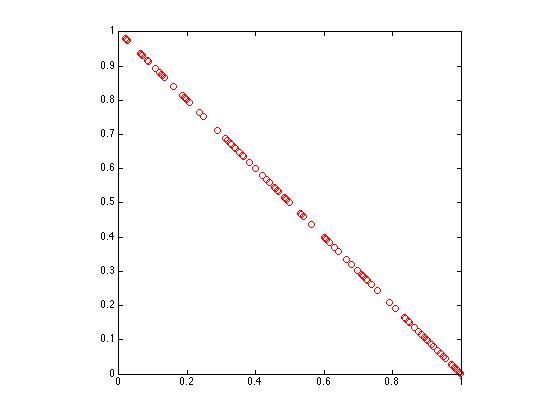
In a low number of dimensions there are some nice tricks to generate a sample that is indeed uniform. I tend to use Roger Stafford's submission to the file exchange, randfixedsum. It is efficient, and works in any number of dimensions.
figure
xyr = randfixedsum(2,100,1,0,1)';
plot(xyr(:,1),xyr(:,2),'ro')
axis equal
axis square
100% Run Guarantee
3-Hour Fast-Track Delivery
Need a Custom Version or Complete Simulation for This Problem?
Our 500+ PhD engineers build, debug, and optimize working MATLAB scripts and Simulink (.slx) models tailored to your exact assignment rubrics with zero plagiarism.
Tested on MATLAB R2024b / R2026a
Turnitin 0% Plagiarism Report
Free 7-Day Revisions Guarantee
Have a different question? Ask here
Related probability random... Questions & Solutions
Browse All →
Explore similar technical troubleshooting questions and verified MATLAB solutions:
Ready-to-Run MATLAB & Simulink Projects
Browse All Projects →