Question
I have the raw data of X, Y, Z, where X and Y are inputs and Z is the output. Plotting the surface gives the red curve in the below picture: The surface seems to be a simple function involving trigonometric functions. For example, plotting the equation cos(X)^2 + cos(Y)^2 gives the blue surface and it looks similar to the red graph (but the RMS error is very large). I have tried introducing variables (a1*cos(X)^2 + a2*cos(Y)^2), where a1 and a2 vary from 0 to 1) but the RMS error is still large. I also tried the surface fitting functions (MATLAB's fit function) but it's models are limited (unlike the curve fitting models which include Fourier series, sin series, etc). How can I find the equation which gives the red surface? Edit for clarity: I am able to use the lsqcurvefit (or any other curve fitting toolbox functions) to find which coefficients to use, but I am not sure what the equation should be. cos(X)^2 + cos(Y)^2, for example, is not the right equation but it does have a similar shape. If this seems improbabilistic, how can I vary cos(X)^2 + cos(Y)^2 to align the end curves of the surface (where there seems to be highest misalignment)?
Expert Answer

Prashant Kumar
PhD Expert
Answered Sep 17, 2026
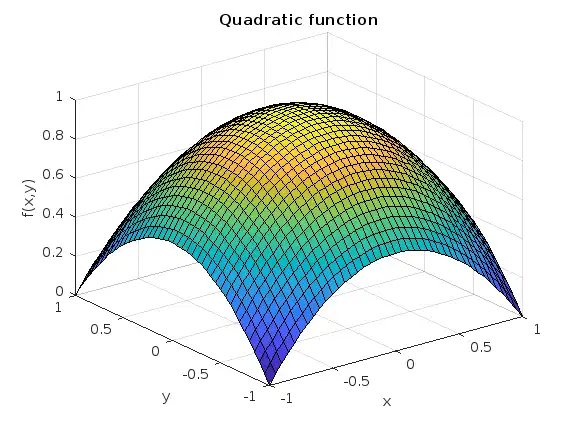
You can probably try this quadratic function  , where
  is a constant, and
  ,
,  .
.
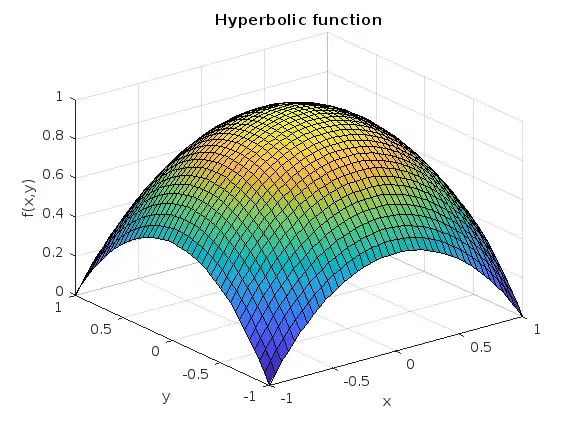
, where is a constant, and , .Update 1: Another candidate function for the surface is hyperbolic function,  .
.
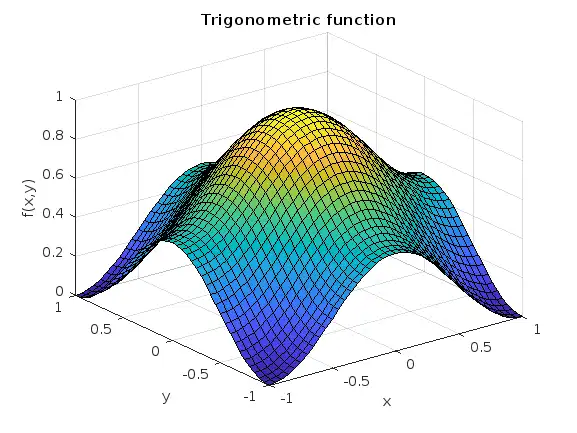
.Update 2: If you insist on using the periodic trigonometric function on a non-oscillatory surface, then modify the fitting model to become  so that it fits the local data.
so that it fits the local data.Update 3: Added some surface plots.
[X, Y] = meshgrid(-1:0.05:1);
%% Polynomial function
c      = 1;
b      = 1/2;
a      = b;
Z      = c - b*Y.^2 - a*X.^2;   % can try higher-order polynomial functions
surf(X, Y, Z), grid on
title('Quadratic function'), xlabel x, ylabel y, zlabel f(x,y)
%% Hyperbolic function
c      = 1/(1 - sech(1));
b      = [1, (c*sech(1))/2];
a      = b;
Z      = c - b(2)*cosh(b(1)*Y) - a(2)*cosh(a(1)*X);
surf(X, Y, Z), grid on
title('Hyperbolic function'), xlabel x, ylabel y, zlabel f(x,y)
%% Trigonometric function (local)
c      = 0;
b      = [pi/2, 1/2];
a      = b;
Z      = c + b(2)*cos(b(1)*Y).^2 + a(2)*cos(a(1)*X).^2;
surf(X, Y, Z), grid on
title('Trigonometric function'), xlabel x, ylabel y, zlabel f(x,y)
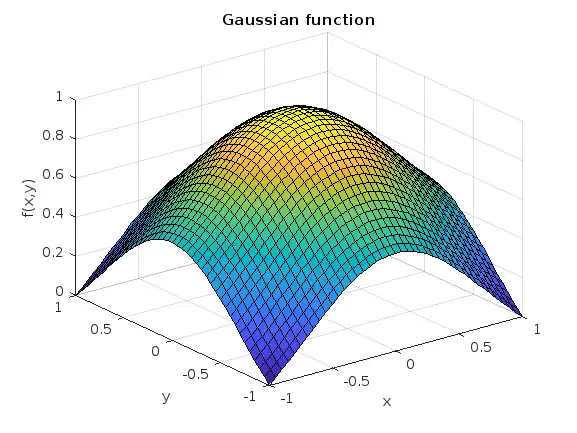
%% Gaussian function (local)
c      = 1/(1 - exp(1));
b      = exp(1)/(2*(exp(1) - 1));
a      = b;
Z      = c + b*exp(-Y.^2) + a*exp(-X.^2);   % can sech(x) if you like single-hump functions
surf(X, Y, Z), grid on
title('Gaussian function'), xlabel x, ylabel y, zlabel f(x,y)
100% Run Guarantee
3-Hour Fast-Track Delivery
Need a Custom Version or Complete Simulation for This Problem?
Our 500+ PhD engineers build, debug, and optimize working MATLAB scripts and Simulink (.slx) models tailored to your exact assignment rubrics with zero plagiarism.
Tested on MATLAB R2024b / R2026a
Turnitin 0% Plagiarism Report
Free 7-Day Revisions Guarantee
Have a different question? Ask here
Related equation Questions & Solutions
Browse All →
Explore similar technical troubleshooting questions and verified MATLAB solutions:
Ready-to-Run MATLAB & Simulink Projects
Browse All Projects →