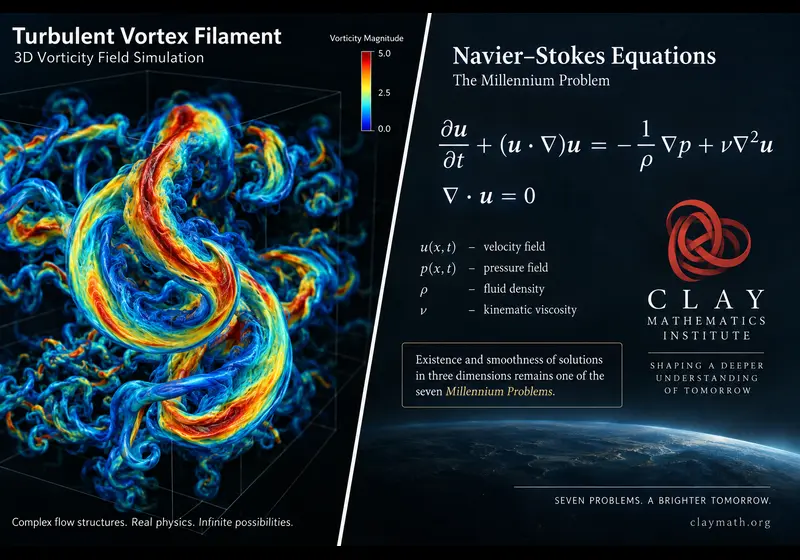
When OpenAI published research suggesting automated models had made progress toward solving the three-dimensional Navier-Stokes equations, mathematicians and simulation engineers took notice immediately. Navier-Stokes existence and smoothness is one of the seven Millennium Prize Problems established by the Clay Mathematics Institute in May 2000, carrying a million-dollar bounty. For more than a century, mathematicians have tried to answer one deceptively simple question: do smooth, physically reasonable solutions to the Navier-Stokes equations always exist for all time in three dimensions, or can fluid velocity blow up into a singularity?
Almost as soon as OpenAI released its paper, an intense academic dispute erupted across Hacker News, Reddit, and mathematics departments. At the center of the dispute was NYU mathematician Tristan Buckmaster, whose prior breakthroughs on convex integration and singularity formation in fluid dynamics appeared heavily reflected in the model's analytical path. Critics questioned whether OpenAI's AI system produced genuine novel mathematics or simply re-packaged Buckmaster's preprint frameworks without adequate attribution.
What OpenAI Actually Claimed
To understand the controversy, you have to look at what OpenAI tried to do. Proving global regularity requires showing that a smooth initial velocity field never leads to infinite kinetic energy or unbounded vorticity. Conversely, disproving it requires constructing a concrete initial state that develops a finite-time singularity.
Rather than tackling the problem through traditional pen-and-paper analysis, OpenAI used deep reinforcement learning and symbolic search to search the functional parameter space for candidate blow-up profiles. The system sought initial velocity fields that forced vortex stretching to outpace viscous dissipation, attempting to drive energy concentration to a singular point.
The company announced that its model identified candidate singularity formations that satisfied the Navier-Stokes equations under specific boundary conditions. To non-mathematicians, this sounded like the problem was solved. To the fluid dynamics and analysis community, the reaction was far more critical.
The Tristan Buckmaster Overlap
The backlash centered on the underlying mathematics. Tristan Buckmaster, working alongside researchers like Camillo De Lellis and Vlad Vicol, had already published foundational papers proving that weak solutions (specifically Leray-Hopf solutions) to the Navier-Stokes equations can fail to be unique, and that related Euler equations develop finite-time singularities.
When analysts inspected OpenAI's paper, the geometric constructions and ansatz profiles looked nearly identical to Buckmaster's preprints on vortex reconnection and boundary layer singularities. Many mathematicians pointed out that the AI did not discover a new analytic pathway. Instead, it automated gradient descent inside the mathematical corridor that Buckmaster and his collaborators had spent a decade carving out.
One commenter on Hacker News summarized the feeling in the research community: if human mathematicians lay the groundwork, map the failure modes, and define the exact Sobolev spaces where singularities might hide, an automated search engine finding numbers inside that box is numerical parameter optimization, not an analytical proof.
Why Simulation Engineers Are Skeptical: Numerical Artifacts vs. Analytic Proofs
Anyone who has run computational fluid dynamics (CFD) in MATLAB, ANSYS Fluent, or OpenFOAM knows a fundamental rule: numerical simulations blow up all the time. But a code crash or an infinite value in a discrete matrix is rarely a mathematical singularity.
In discrete solvers, several common issues mimic singularities:
- Grid Resolution Limits: When grid spacing is coarser than the Kolmogorov microscale, unresolved sub-grid turbulent eddies cause energy to accumulate, triggering artificial numerical blow-ups.
- Discretization Dissipation: High-order central difference schemes can become unstable without artificial viscosity, creating steep gradients that look like shockwaves or point singularities.
- Floating-Point Overflow: Extreme localized pressure spikes can cause double-precision numbers to exceed standard bounds without indicating continuous mathematical blow-up.
For a Millennium Prize proof, the Clay Institute does not accept numerical convergence. You have to prove smooth continuity across continuous Sobolev spaces for all positive time, or construct a rigorous analytical bound showing the velocity gradient reaches infinity in finite time. A neural network outputting a high-loss gradient spike is a computational signal, not a rigorous mathematical demonstration.
How to Verify Nonlinear PDE Stability in MATLAB
For researchers and engineers working with fluid transport equations, checking whether a system is heading toward physical instability or a numerical artifact requires rigorous diagnostic routines. In MATLAB, you can track energy dissipation and vorticity dynamics directly to spot unphysical growth.
Here is a basic verification pattern in MATLAB using the PDE Toolbox or finite-difference schemes to monitor the total kinetic energy integral over time:
% Monitor kinetic energy conservation and enstrophy in 2D/3D flow
function [time_vec, kinetic_energy, enstrophy] = verify_fluid_stability(u, v, dx, dy, dt, steps)
    time_vec = zeros(steps, 1);
    kinetic_energy = zeros(steps, 1);
    enstrophy = zeros(steps, 1);

    for t = 1:steps
        % Calculate kinetic energy: 0.5 * integral(u^2 + v^2) dV
        ke = 0.5 * sum(sum(u.^2 + v.^2)) * dx * dy;

        % Calculate vorticity: omega = dv/dx - du/dy
        [~, du_dy] = gradient(u, dy);
        [dv_dx, ~] = gradient(v, dx);
        vorticity = dv_dx - du_dy;

        % Calculate enstrophy: 0.5 * integral(omega^2) dV
        ens = 0.5 * sum(sum(vorticity.^2)) * dx * dy;

        time_vec(t) = t * dt;
        kinetic_energy(t) = ke;
        enstrophy(t) = ens;

        % Stop immediately if energy diverges abnormally
        if isnan(ke) || ke > 1e7
            warning('Unstable solution detected at step %d. Possible numerical blow-up.', t);
            break;
        end
    end
end
If kinetic energy climbs without bound in a closed system without external driving forces, the simulation violates the fundamental energy inequality of the Navier-Stokes equations, indicating a solver breakdown rather than physical turbulence.
The Real Takeaway for AI in Physical Sciences
The OpenAI Navier-Stokes controversy highlights a persistent gap in modern AI research. Large language models and neural surrogate solvers excel at interpolation, curve fitting, and accelerating standard mesh evaluations. They can compress hours of CFD simulation down to milliseconds.
What they cannot do yet is provide self-contained formal verification. Claiming credit for solving classical mathematical problems requires complete transparency regarding prior academic literature and strict adherence to formal proof systems like Lean or Coq. Until AI models can construct verifiable, step-by-step proofs from first principles, claims of solving the Millennium Prize problems will remain computational experiments rather than mathematical milestones.
Related Verified MATLAB & Simulink Projects
Need pre-built, debugged Simulink models with complete parameter initialization scripts and documentation? Explore top related solutions:
Common Engineering Troubleshooting & Q&A
Frequently encountered bugs, solver convergence issues, and implementation questions answered by our engineering mentors:
Recommended Engineering Articles
Need Custom MATLAB / Simulink Implementation?
Our team of PhD engineers build custom simulation plants, train machine learning agents, tune PID/MPC controllers, and deliver complete, executable code with Turnitin reports.