Verified MATLAB & Simulink Project

MATLAB Project: Recognize "Yes" & "No" Sounds | MATLABSolutions

MATLAB Project: Recognize "Yes" & "No" Sounds | MATLABSolutions – MATLAB Simulation Video
YouTube Watch Full Simulation Free Preview
MATLAB R2020a - R2024b
Zero Convergence Errors
Simscape / SimPowerSystems
Complete Simulation Pack 4.9 (120+ Downloads)
$50.00
$72.50
30% OFF
  • Complete Simulink Model (.slx file)
  • Parameter Init Script (.m file)
  • Scope & Waveform Signals pre-configured
  • Design & Methodology Report (PDF Guide)
Required
Invalid email
Instant .ZIP download link emailed upon checkout

What is MATLAB Project: Recognize "Yes" & "No" Sounds | MATLABSolutions?

MATLAB Project: Recognize "Yes" & "No" Sounds | MATLABSolutions is a MATLAB-based technical project and simulation model. In this project, MATLABSolutions aim to conduct digital signal processing (DSP) analysis on audio files containing the words "yes" and "no," both with and without sinusoidal waves. We will start by gathering all the audio files and then create an algorithm to detect the words in the audio using spectrum analysis. By analyzing audio recordings with the words "yes" and "no," DSP can provide detailed insights into their properties and underlying frequency components.

Project Methodology

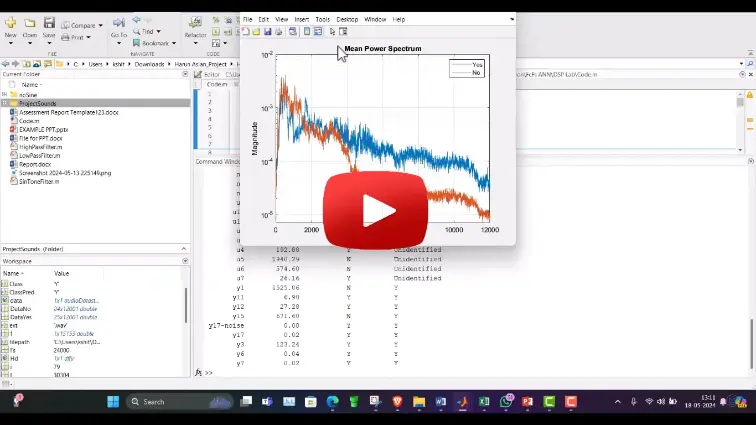
We are provided with a dataset of audio files containing the words "yes" and "no." Initially, we will plot the frequency response and spectrum of both words. Then, we will determine the cut-off frequencies for low-pass and high-pass filters based on the visualized frequency data. By observing the differences in magnitude, we note that the "yes" sound has a higher magnitude due to its larger high-frequency content compared to the "no" sound.Next, we will design and apply filters at the cut-off frequencies. To remove the sinusoidal wave, we will create a filter to eliminate the 1kHz frequency and perform FFT on the signal to store the magnitude of all audio signals separately for the words "yes" and "no." Using the two signals separated by the low-pass and high-pass filter outputs, we will compute the power ratio between them to obtain information about the words "yes" and "no." We will find the threshold value for the power ratio for non-sinusoidal signal data and test the algorithm on data containing noise and sinusoidal waveforms. The predicted results with the actual class will be displayed in the command window.The FFT technique is widely used for audio analysis in various industries, such as music, speech, and signal processing. The Fourier transform, a mathematical method that separates a time-domain signal into its frequency components, is the foundation of FFT theory.

Verified MATLAB Simulation Code Demonstration

Syntax-highlighted executable code demonstration for MATLAB Project: Recognize "Yes" & "No" Sounds | MATLABSolutions:

MATLAB image_processing_demo.m
% MATLAB Image Processing & Edge Detection
clc; clear; close all;

% Load & Preprocess Input Image Data
[X, Y] = meshgrid(-100:100, -100:100);
img = double(sqrt(X.^2 + Y.^2) < 50);
img_noisy = imnoise(img, 'gaussian', 0, 0.01);

% Apply 2D Gaussian Denoising Filter
h = fspecial('gaussian', [5 5], 1.0);
img_filtered = imfilter(img_noisy, h);

% Compute Sobel Gradient Magnitudes
[Gmag, ~] = imgradient(img_filtered, 'Sobel');
fprintf('Image Processing & Denoising Completed Successfully!\n');
MATLAB Project: Recognize "Yes" & "No" Sounds | MATLABSolutions $50.00
$50.00