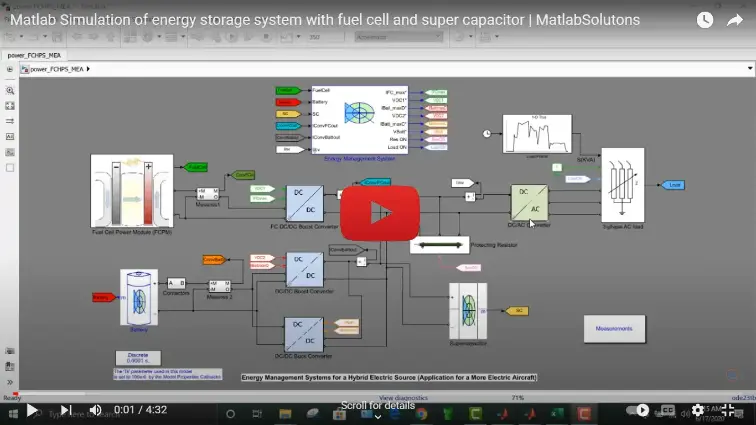
What is Energy Storage: Fuel Cell, Battery & MATLAB Simulation?
Energy Storage: Fuel Cell, Battery & MATLAB Simulation is a MATLAB-based technical project and simulation model. Hybrid Energy Storage Systems (HESS) combining Fuel Cells (FC), Lithium-Ion Batteries, and Supercapacitors (SC) offer a balanced power solution for electric vehicles, aerospace systems, and renewable microgrids. Proton Exchange Membrane Fuel Cells (PEMFC) provide high energy density for long-range baseload operation, but have slow dynamic response times due to internal electrochemical and thermodynamic delays. Pairing the fuel cell with a battery for intermediate energy storage and a supercapacitor for high-power transients protects the fuel cell membrane from oxygen starvation and extends battery cycle life. This project covers the modeling and simulation of a multi-source hybrid power system in MATLAB Simulink, including dedicated DC-DC converter topologies, DC bus voltage stabilization, and frequency-split Energy Management Strategies (EMS).
Project Methodology
The design and simulation of a Fuel Cell, Battery, and Supercapacitor hybrid energy storage system in MATLAB Simulink follows a structured, step-by-step procedure:
- Multi-Source Electrical Modeling: Model individual energy sources in Simscape Electrical:
- A PEM Fuel Cell stack parameterized by activation, ohmic, and concentration polarization voltage drops.
- A Lithium-Ion battery pack with state-of-charge (SoC) estimation and dynamic internal resistance.
- An Electric Double-Layer Supercapacitor (EDLC) with equivalent series resistance (ESR) and high-capacitance dynamics.
- Power Electronics Converter Topology: Build a unidirectional DC-DC boost converter for the fuel cell, alongside two bidirectional DC-DC buck-boost converters for the battery and supercapacitor to interface with a common 400V/700V DC bus.
- Local Converter Closed-Loop Control: Design cascaded PI controllers with inner inductor current loops and outer capacitor voltage loops to achieve fast reference tracking and ensure stable PWM switching.
- Frequency-Decoupled Energy Management (EMS): Implement a frequency-separation algorithm using Low-Pass Filters (LPF) to distribute load power:
- Steady-state, low-frequency power demand is allocated to the fuel cell.
- Intermediate-frequency variations are handled by the battery pack.
- High-frequency transients, load steps, and regenerative braking surges are absorbed by the supercapacitor.
- DC Bus Voltage Regulation: Design supervisory bus stabilization logic to keep the common DC link voltage within a ±2% tolerance window during sudden load switching and source transitions.
- Dynamic Drive Cycle Simulation: Run simulation cases under sudden step-load increments, load shedding, and standard automotive driving schedules (such as UDDS or WLTP) to verify power-sharing accuracy.
- Performance Analysis & Stress Metrics: Evaluate fuel cell hydrogen flow rate, battery degradation stress reduction, supercapacitor voltage limits, DC bus ripple percentage, and overall multi-converter efficiency.
Verified MATLAB Simulation Code Demonstration
Syntax-highlighted executable code demonstration for Energy Storage: Fuel Cell, Battery & MATLAB Simulation:
% State-Space Control & Stability Analysis
clc; clear; close all;

% System Matrices
A = [0 1; -4 -5];
B = [0; 1];
C = [1 0];
D = 0;

sys_ss = ss(A, B, C, D);
Co = ctrb(A, B);

% Pole Placement Control
desired_poles = [-3 + 4i, -3 - 4i];
K = acker(A, B, desired_poles);

sys_cl = ss(A - B*K, B, C, D);
fprintf('State Feedback Controller Formulated Successfully!\n');