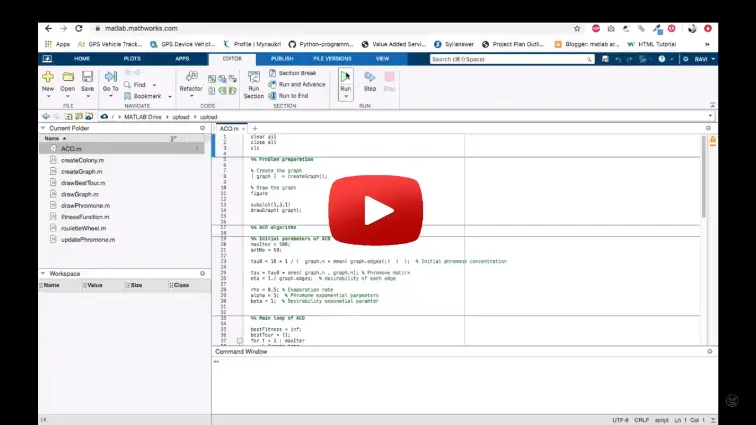
What is Ant Colony Algorithms implementation In MATLAB?
Ant Colony Algorithms implementation In MATLAB is a MATLAB-based technical project and simulation model. Ant Colony Optimization (ACO) is a swarm intelligence method modeled on the foraging behavior of real ants, which locate optimal paths using chemical pheromone trails. In MATLAB, ACO is commonly applied to solve complex combinatorial problems, including the Traveling Salesperson Problem (TSP), network routing, job-shop scheduling, and feature selection. This guide covers the core mechanics of ACO, from initializing pheromone and heuristic matrices to coding probabilistic path selection and pheromone evaporation routines for practical engineering problems.
Project Methodology
Implementing Ant Colony Optimization in MATLAB follows a structured, step-by-step computational workflow:
- Problem Formulation and Matrix Setup: Define the objective function and construct the problem space, such as an N-by-N distance or cost matrix derived from node coordinates.
- Parameter Initialization: Configure the swarm size (number of ants), maximum iteration limit, pheromone weighting factor (alpha), heuristic visibility factor (beta), and pheromone evaporation rate (rho).
- Pheromone and Heuristic Matrix Initialization: Set an initial uniform pheromone level across all edges and compute the heuristic desirability matrix using the inverse of edge distances.
- Probabilistic Path Construction: Release ants across starting nodes and determine each subsequent transition using a roulette-wheel selection rule based on pheromone concentration and heuristic values.
- Tour Evaluation and Best-Cost Tracking: Calculate the total route length or fitness score for every ant upon tour completion, updating the global best solution found so far.
- Pheromone Evaporation and Deposit: Apply the evaporation factor to all trails to avoid stagnation in local minima, then reinforce the edges traveled by the best-performing ants with additional pheromone.
- Convergence Analysis and Route Plotting: Run the loop until reaching the maximum iteration count or convergence criteria, then plot the cost reduction curve and optimal route trajectory in MATLAB.
Verified MATLAB Simulation Code Demonstration
Syntax-highlighted executable code demonstration for Ant Colony Algorithms implementation In MATLAB:
% MATLAB Constrained Numerical Optimization
clc; clear; close all;

obj_fun = @(x) (x(1)-2)^2 + (x(2)-3)^2;
x0 = [0, 0]; A = [1, 2]; b = 4; lb = [0, 0];

options = optimoptions('fmincon', 'Display', 'off', 'Algorithm', 'sqp');
[x_opt, fval] = fmincon(obj_fun, x0, A, b, [], [], lb, [], [], options);

fprintf('Optimization Solved: Minimum Value = %.4f\n', fval);