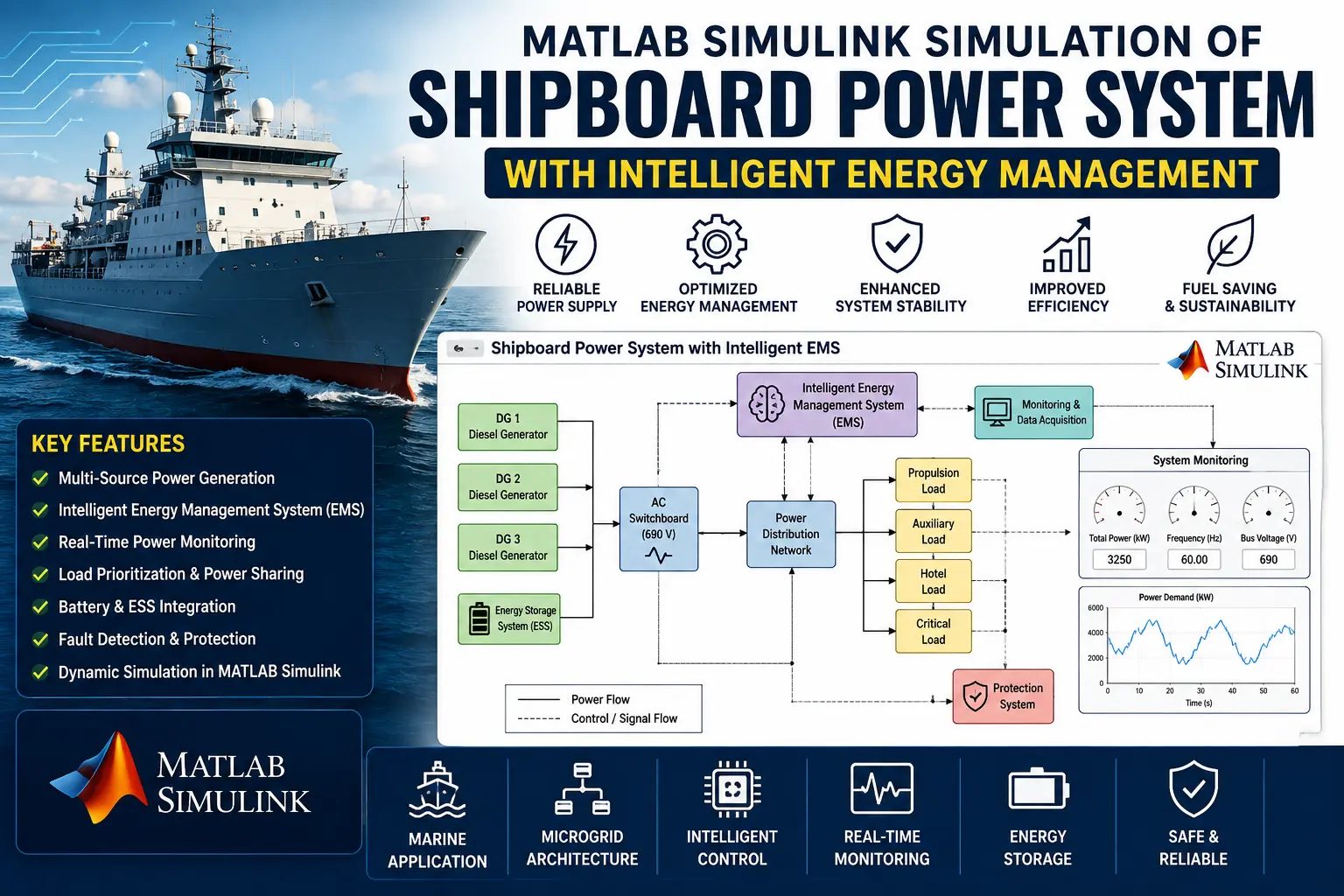
What is MATLAB Simulink Simulation of Shipboard Power System with Intelligent Energy Management?
MATLAB Simulink Simulation of Shipboard Power System with Intelligent Energy Management is a MATLAB-based technical project and simulation model. Modern All-Electric Ships (AES) and marine vessels consolidate propulsion drives, service hotel loads, and mission systems onto a unified electrical distribution network. A Shipboard Power System (SPS) operates as an isolated, tightly coupled islanded microgrid where electric propulsion motors consume up to 80% of total generation capacity, and mission loads can introduce high-energy Pulsed Power Loads (PPL) that cause severe frequency and voltage disturbances. Coordinating prime movers (diesel generators and gas turbines) with hybrid energy storage systems (batteries and supercapacitors) requires an intelligent Energy Management System (EMS) to optimize fuel efficiency, buffer sudden load steps, and prevent blackout conditions during naval maneuvering. In MATLAB and Simulink, using Simscape Electrical allows marine power engineers to model generator governors, variable-frequency propulsion drives, bidirectional storage converters, and supervisory EMS controllers. This project covers the architectural modeling, intelligent load-dispatch control, pulsed load mitigation, and dynamic stability simulation of a shipboard power system in MATLAB.
Project Methodology
The design, modeling, and dynamic simulation of an all-electric shipboard power system with intelligent energy management in MATLAB Simulink follows a structured marine power systems workflow:
- Shipboard Grid Architecture & Single-Line Setup: Build a Medium-Voltage AC (MVAC, 4.16 kV / 60 Hz) or Medium-Voltage DC (MVDC, 5 kV) shipboard distribution network in Simscape Electrical, configuring multi-generator busbars, step-down service transformers, and localized load distribution centers.
- Marine Generation & Prime Mover Modeling:
- Model multiple marine diesel engines and aeroderivative gas turbines with dynamic speed governors (DEGOV and GAST blocks).
- Couple mechanical shafts to salient-pole synchronous generators equipped with IEEE Type-1 Automatic Voltage Regulators (AVRs) to maintain generator terminal voltages at 1.0 per unit.
- Electric Propulsion Drive Subsystem: Model multi-megawatt propulsion motors (Permanent Magnet Synchronous Motors or Induction Motors) driven by multi-level Voltage Source Inverters with Field-Oriented Control (FOC), integrating non-linear hydrodynamic propeller load torque curves based on ship speed and sea state.
- Hybrid Energy Storage & Pulsed Power Load (PPL) Setup:
- Model Lithium-Ion battery banks and high-power supercapacitors interfaced via bidirectional DC-DC converters to supply fast transient response and peak shaving.
- Simulate repetitive high-power pulsed electrical loads (such as electromagnetic launchers or pulse radar arrays) to evaluate sudden power demand steps.
- Intelligent Energy Management System (EMS) Design: Program a supervisory EMS in MATLAB using Model Predictive Control (MPC), Fuzzy Logic, or Stateflow logic:
- Optimal Generator Scheduling: Allocating active and reactive power among operating generator sets to maximize thermal fuel efficiency.
- Pulsed Load Buffer Dispatch: Discharging supercapacitor and battery units during pulsed events to shield main generators from severe electromechanical shock.
- Contingency Load Shedding: Automatically disconnecting non-critical hotel services during generator tripping to prevent cascading microgrid collapse.
- Dynamic Marine Scenario & Maneuver Testing: Simulate challenging operational conditions in Simulink, including crash-stop emergency reversals, full-ahead sea acceleration, severe sea-state wave torque oscillations, and pulsed weapon firing cycles.
- Power Quality & Marine Standard Verification: Monitor system frequency deviations (±3%), bus voltage regulation (±5%), and AC current Total Harmonic Distortion (THD < 5%) using the MATLAB Powergui tool, verifying compliance with IEEE 1709 and IEEE 45 marine electrical standards.
Verified MATLAB Simulation Code Demonstration
Syntax-highlighted executable code demonstration for MATLAB Simulink Simulation of Shipboard Power System with Intelligent Energy Management:
% Dynamic Physical Model & Solver Configuration
clc; clear; close all;

% Hydraulic & Mechanical ODE System Parameters
m = 1.0; c = 0.5; k = 9.0;
ode_sys = @(t, y) [y(2); -(c/m)*y(2) - (k/m)*y(1)];

% Numerical ODE Integration
tspan = [0 10]; y0 = [1.0; 0.0];
[t, y] = ode45(ode_sys, tspan, y0);

fprintf('ODE Physical System Solved across %d Time Steps!\n', length(t));