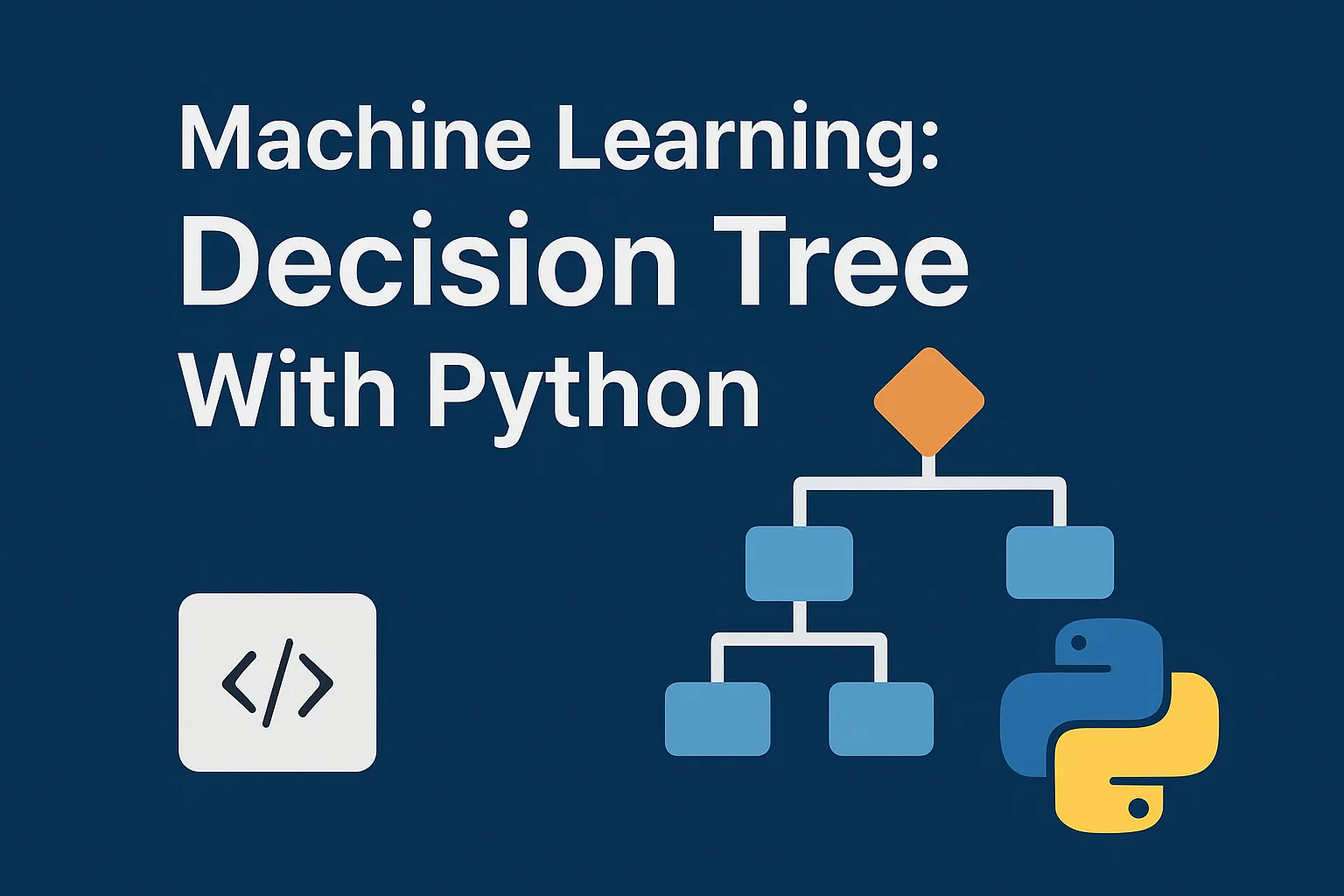
Decision Trees are among the most intuitive and transparent machine learning algorithms available. Unlike "black-box" models that hide their inner logic, a decision tree mirrors human decision-making by asking a sequence of targeted questions about your data to reach a logical prediction.
Implementing a Decision Tree in Python allows you to solve both classification problems (such as email spam filtering) and regression problems (such as estimating house prices) using simple, highly interpretable code.
What Is a Decision Tree?
A Decision Tree is a flowchart-like model that divides a complex dataset into smaller, more manageable subsets based on specific feature conditions.
- Root Node: The entry point representing the entire dataset and the most decisive feature.
- Decision Nodes: Intermediate test points that split data based on specific conditions.
- Branches: Logical paths connecting nodes based on test outcomes.
- Leaf Nodes: Terminal nodes representing final predictions or class assignments.
How Decision Trees Split Data
During training, the algorithm evaluates every available feature and selects the best split point using mathematical metrics:
- Gini Impurity: Measures how often a randomly chosen element would be incorrectly labeled. Lower impurity means cleaner splits.
- Entropy & Information Gain: Measures randomness or uncertainty in data. The algorithm picks splits that maximize Information Gain.
Advantages of Decision Trees
- High Interpretability: Decision paths can be easily visualized and explained to non-technical stakeholders.
- Minimal Data Preparation: Does not require feature scaling, normalization, or standardization.
- Handles Mixed Data: Processes numerical and categorical features seamlessly.
- Non-linear Relationships: Captures complex non-linear feature interactions without feature engineering.
Limitations & How to Fix Them
- Overfitting: Deep trees can memorize training noise. Fix: Set a maximum depth (
max_depth) or prune unnecessary branches. - Structural Instability: Minor data variations can alter the tree structure. Fix: Use ensemble models like Random Forests or Gradient Boosting.
- Class Imbalance Bias: Dominant classes can skew splits. Fix: Balance sample weights or adjust node thresholding.
Decision Tree Implementation in Python
Using Python's scikit-learn library, building and evaluating a decision tree classifier takes only a few lines of code:
from sklearn.datasets import load_iris
from sklearn.model_selection import train_test_split
from sklearn.tree import DecisionTreeClassifier, export_text
from sklearn.metrics import accuracy_score

# Load sample dataset
iris = load_iris()
X_train, X_test, y_train, y_test = train_test_split(
    iris.data, iris.target, test_size=0.2, random_state=42
)

# Initialize and train Decision Tree Classifier
clf = DecisionTreeClassifier(max_depth=3, criterion='gini', random_state=42)
clf.fit(X_train, y_train)

# Make predictions and evaluate performance
y_pred = clf.predict(X_test)
print(f"Model Accuracy: {accuracy_score(y_test, y_pred) * 100:.2f}%")

# Print text representation of decision rules
tree_rules = export_text(clf, feature_names=iris.feature_names)
print(tree_rules)
Real-World Applications
- Healthcare & Diagnostics: Mapping clinical symptoms to disease diagnoses.
- Financial Services: Assessing borrower creditworthiness and loan default risks.
- Marketing Analytics: Segmenting customer groups based on purchase behavior.
- Quality Control: Detecting manufacturing defects in automated production lines.
Related Verified MATLAB & Simulink Projects
Need pre-built, debugged Simulink models with complete parameter initialization scripts and documentation? Explore top related solutions:
Common Engineering Troubleshooting & Q&A
Frequently encountered bugs, solver convergence issues, and implementation questions answered by our engineering mentors:
Recommended Engineering Articles
Need Custom MATLAB / Simulink Implementation?
Our team of PhD engineers build custom simulation plants, train machine learning agents, tune PID/MPC controllers, and deliver complete, executable code with Turnitin reports.