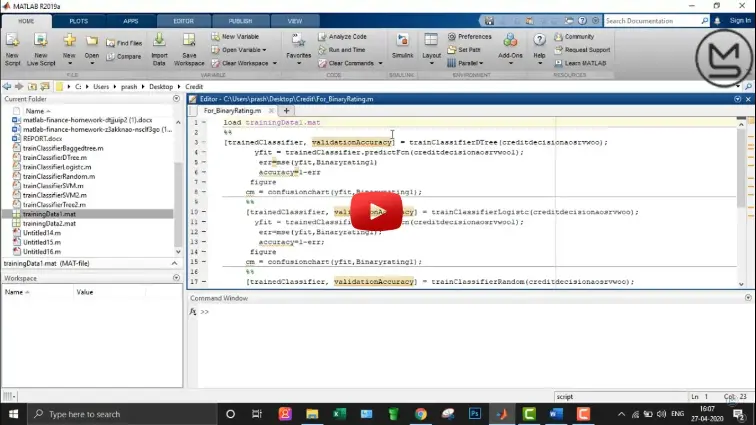
What is Machine Learning in Finance for Binary Credit Rating Classification in MATLAB?
Machine Learning in Finance for Binary Credit Rating Classification in MATLAB is a MATLAB-based technical project and simulation model. Credit risk assessment and credit rating classification are essential operations for financial institutions, credit card issuers, and risk management teams evaluating counterparty default exposure. Determining whether a borrower or corporate entity is classified as investment-grade or speculative-grade (binary rating: non-default vs. default) requires analyzing extensive financial ratios, historical payment trajectories, credit utilization percentages, and macroeconomic indicators. Traditional credit scorecards often struggle to capture non-linear relationships and interactions present in multi-dimensional credit datasets. In MATLAB, the Statistics and Machine Learning Toolbox provides a comprehensive data science environment to preprocess financial tables, correct severe class imbalances, engineer domain-specific credit features, and train supervised classifiers. This project covers financial data cleaning, class rebalancing using SMOTE, feature selection via MRMR, and the implementation of multiple machine learning models (Logistic Regression, Support Vector Machines, Random Forests, and Gradient Boosted Trees) evaluated with financial risk metrics including ROC-AUC and the Kolmogorov-Smirnov (K-S) statistic.
Project Methodology
The implementation of machine learning for binary credit rating and credit card default classification in MATLAB follows a structured quantitative finance workflow:
- Dataset Ingestion & Financial Schema Mapping: Import credit card customer datasets or corporate financial ratio tables into MATLAB
tablestructures, mapping continuous financial predictors (leverage ratio, current ratio, debt-to-equity, revolving line utilization, payment delay histories) alongside binary rating labels (0 for non-default, 1 for default). - Data Preprocessing & Winsorization: Clean raw records by imputing missing values with k-nearest neighbors estimation, standardizing numerical scales using z-score normalization, and applying percentile winsorization to suppress extreme financial ratio outliers without discarding data points.
- Class Imbalance Correction: Mitigate severe class disparities (where non-default accounts significantly outnumber default cases) using Synthetic Minority Over-sampling Technique (SMOTE) or by configuring cost-sensitive misclassification penalty cost matrices in MATLAB algorithms.
- Feature Selection & Risk Driver Ranking: Apply Minimum Redundancy Maximum Relevance (
fscmrmr) and Principal Component Analysis (pca) to identify the strongest credit risk indicators, eliminating collinear variables to improve model explainability and prevent overfitting. - Supervised Model Training & Implementation: Train multiple supervised learning architectures in MATLAB:
- Logistic Regression: Fit generalized linear models using
fitglmwith a binomial logit distribution for interpretable credit scorecard generation. - Support Vector Machines (SVM): Train non-linear classifiers using
fitcsvmwith Gaussian Radial Basis Function (RBF) kernels. - Ensemble Decision Trees: Implement Random Forests (
TreeBagger) and Gradient Boosted Trees (fitcensemblewith AdaBoost/LogitBoost) to capture non-linear feature interactions. - Artificial Neural Networks (ANN): Configure multi-layer feedforward networks for deep credit pattern recognition.
- Logistic Regression: Fit generalized linear models using
- Hyperparameter Tuning & Stratified Cross-Validation: Optimize hyperparameters (regularization strength, tree split counts, learning rate shrinkage) using Bayesian optimization, validating predictive robustness using stratified 10-fold cross-validation.
- Credit Risk Metric Evaluation & Benchmarking: Evaluate models using the
perfcurveutility to generate multi-model ROC curves, calculating Area Under the Curve (ROC-AUC), the Gini Coefficient (2 × AUC - 1), the Kolmogorov-Smirnov (K-S) separation statistic, confusion charts, and expected default loss reduction curves.
Verified MATLAB Simulation Code Demonstration
Syntax-highlighted executable code demonstration for Machine Learning in Finance for Binary Credit Rating Classification in MATLAB:
% MATLAB Deep Learning CNN Classification
clc; clear; close all;

% Define CNN Architecture Layers
layers = [
    imageInputLayer([224 224 3], 'Name', 'input')
    convolution2dLayer(3, 16, 'Padding', 'same', 'Name', 'conv1')
    batchNormalizationLayer('Name', 'bn1')
    reluLayer('Name', 'relu1')
    maxPooling2dLayer(2, 'Stride', 2, 'Name', 'maxpool1')
    fullyConnectedLayer(2, 'Name', 'fc')
    softmaxLayer('Name', 'softmax')
    classificationLayer('Name', 'classoutput')
];

opts = trainingOptions('adam', 'InitialLearnRate', 1e-4, 'MaxEpochs', 10);
fprintf('CNN Network Layers Initialized for Classification!\n');