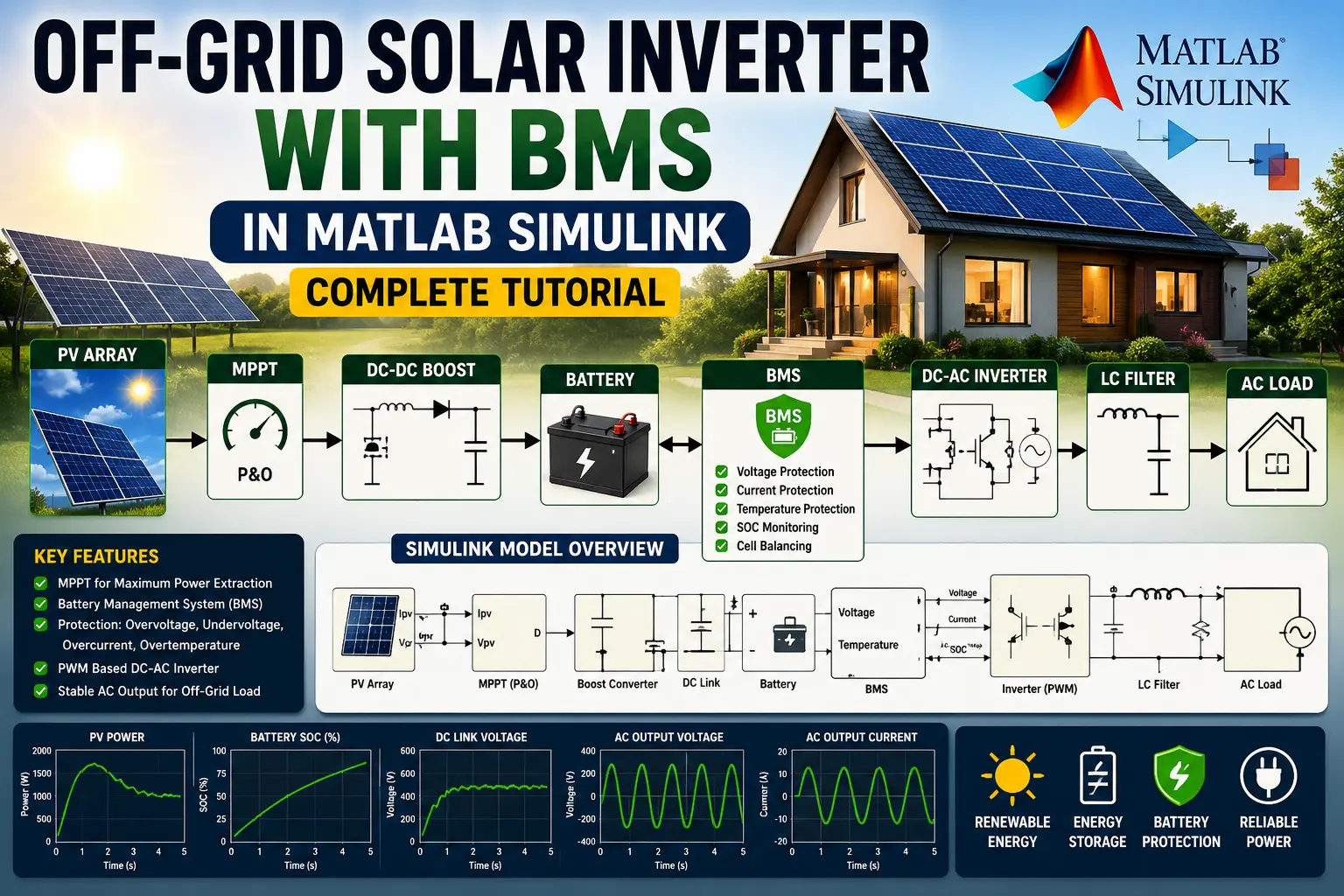
What is Off-Grid Solar Inverter with Battery Management System (BMS) in MATLAB Simulink | Complete Tutorial?
Off-Grid Solar Inverter with Battery Management System (BMS) in MATLAB Simulink | Complete Tutorial is a MATLAB-based technical project and simulation model. An Off-Grid Solar Inverter is a standalone photovoltaic (PV) power system designed to supply electricity without relying on the utility grid. It integrates solar panels, a battery bank, a Battery Management System (BMS), an inverter, and an energy management strategy to provide reliable power to residential, commercial, and remote applications. In this MATLAB Simulink tutorial, we develop a complete off-grid solar inverter model incorporating a PV array, Maximum Power Point Tracking (MPPT), DC-DC boost converter, battery energy storage system, Battery Management System (BMS), DC-AC inverter, LC filter, and AC load. The BMS continuously monitors battery voltage, current, temperature, and State of Charge (SOC) to ensure safe charging and discharging while protecting the battery from overvoltage, undervoltage, overcurrent, and overheating.
Project Methodology
The Off-Grid Solar Inverter with BMS is developed in MATLAB Simulink using the following methodology:
- PV Array Modeling
- Design the photovoltaic array based on the required power rating.
- Simulate varying irradiance and temperature conditions.
- MPPT Controller
- Implement the Perturb and Observe (P&O) algorithm to extract maximum power from the PV array.
- Generate duty-cycle signals for the boost converter.
- DC-DC Boost Converter
- Regulate the PV output voltage.
- Maintain a stable DC-link voltage for charging the battery and supplying the inverter.
- Battery Energy Storage System
- Model the lithium-ion battery.
- Simulate charging and discharging behavior.
- Battery Management System (BMS)
- Monitor battery voltage, current, temperature, and State of Charge (SOC).
- Implement protection against:
- Overvoltage
- Undervoltage
- Overcurrent
- Overtemperature
- Deep discharge
- DC-AC Inverter
- Convert DC power into AC using PWM-based switching.
- Supply a stable AC voltage to the connected load.
- Output Filter
- Use an LC filter to reduce harmonic distortion.
- Improve output voltage quality.
- Load Analysis
- Connect residential or standalone AC loads.
- Evaluate voltage regulation, power delivery, battery SOC, and inverter performance under different operating conditions.
- Performance Evaluation
- Analyze:
- PV power
- Battery voltage and SOC
- DC-link voltage
- Inverter output voltage
- Output current
- System efficiency
- Load response
- Analyze:
Verified MATLAB Simulation Code Demonstration
Syntax-highlighted executable code demonstration for Off-Grid Solar Inverter with Battery Management System (BMS) in MATLAB Simulink | Complete Tutorial:
% Dynamic Physical Model & Solver Configuration
clc; clear; close all;

% Hydraulic & Mechanical ODE System Parameters
m = 1.0; c = 0.5; k = 9.0;
ode_sys = @(t, y) [y(2); -(c/m)*y(2) - (k/m)*y(1)];

% Numerical ODE Integration
tspan = [0 10]; y0 = [1.0; 0.0];
[t, y] = ode45(ode_sys, tspan, y0);

fprintf('ODE Physical System Solved across %d Time Steps!\n', length(t));