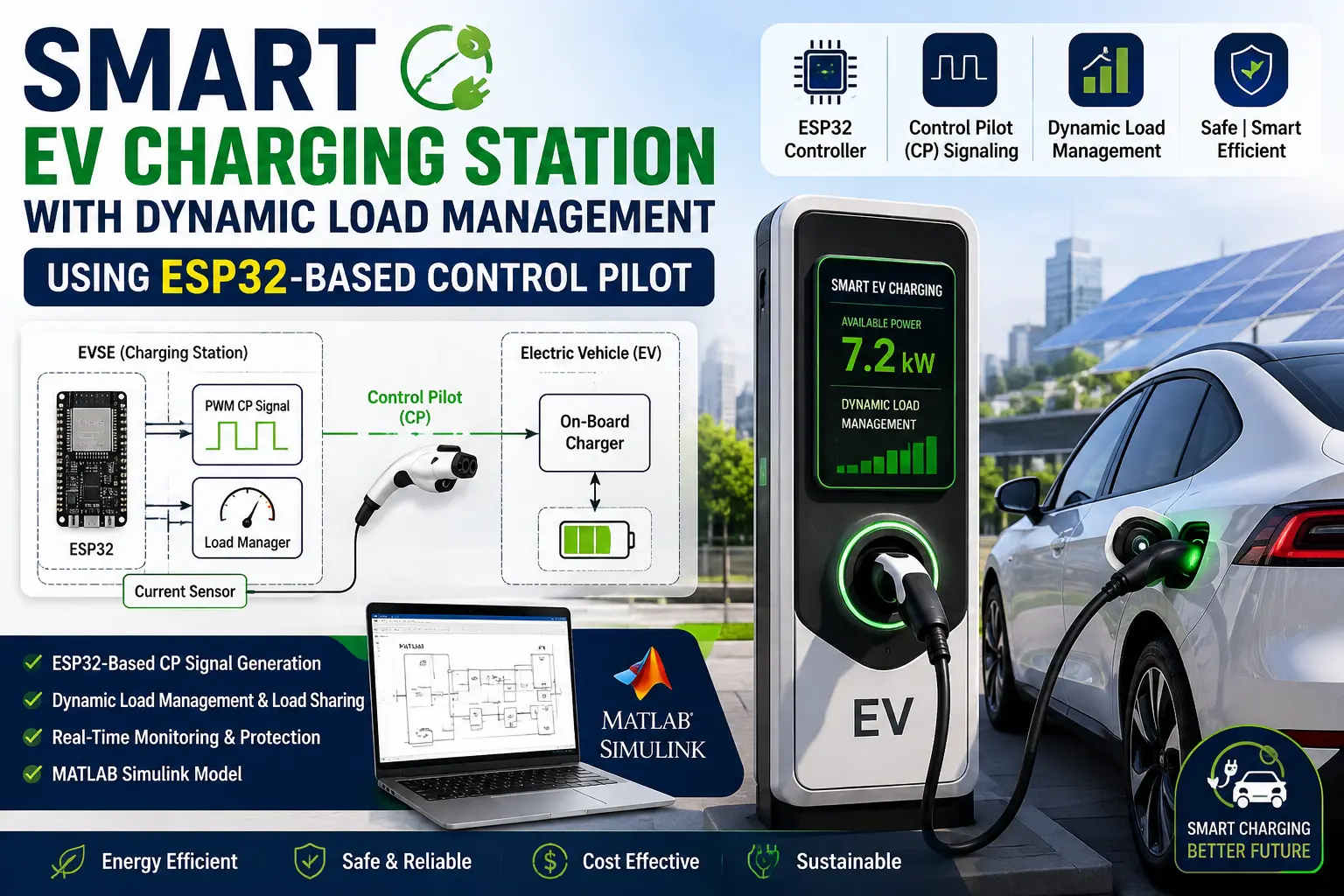
What is Smart EV Charging Station with Dynamic Load Management Using ESP32-Based Control Pilot?
Smart EV Charging Station with Dynamic Load Management Using ESP32-Based Control Pilot is a MATLAB-based technical project and simulation model. This simulation model design, implementation, debugging, and verification of a Simulink model that simulates a smart single-phase EV charging station built around an ESP32-based controller and IEC 61851-style Control Pilot (CP) signaling. The system's purpose is to demonstrate how an EVSE (Electric Vehicle Supply Equipment) can share a limited household electrical panel with domestic appliances, dynamically adjusting the EV's charging current so that total consumption never exceeds the installation's breaker rating, while communicating its status to the vehicle through the standardized CP interface. The project was specified by two requirement briefs describing (a) the electrical characteristics of the CP signal and the vehicle-side states it must support, and (b) the household appliance disturbances the control algorithm must reject in real time. Both are reproduced below, followed by a full account of how each requirement was implemented, tested, and — where problems were discovered during simulation — corrected.
Project Methodology
Simulink Model Overview
The EV_CP_PowerSystem.slx model uses a fixed-step discrete solver (Ts = 5e-6 s) to accurately generate the 1 kHz Control Pilot (CP) signal. Key subsystems include HouseholdLoad, ESP32_Controller, CP_Signal_Generator, EV_Response, and EVSE_Relay, enabling dynamic load management, CP signaling, and safety-based relay control.
Implementation Details
-
HouseholdLoad: Simulates household power demand with appliance disturbances (water heater, shower, induction cooktop) to evaluate controller performance.
-
ESP32_Controller: Estimates available charging capacity using an EMA filter, adjusts CP duty cycle with rate limiting, and disconnects charging immediately during CP faults.
-
CP_Signal_Generator: Produces the IEC 61851-compliant 1 kHz ±12 V / +9 V Control Pilot waveform, with +12 V idle when no EV is connected.
-
EV_Response: Models standard CP states using pull-down resistances to determine vehicle charging behaviour and current demand.
-
State Trigger Generation: Sample-based pulse generators automatically cycle through all CP states during a 6-second simulation using the model's 5e-6 s sample time.
Verified MATLAB Simulation Code Demonstration
Syntax-highlighted executable code demonstration for Smart EV Charging Station with Dynamic Load Management Using ESP32-Based Control Pilot:
% State-Space Control & Stability Analysis
clc; clear; close all;

% System Matrices
A = [0 1; -4 -5];
B = [0; 1];
C = [1 0];
D = 0;

sys_ss = ss(A, B, C, D);
Co = ctrb(A, B);

% Pole Placement Control
desired_poles = [-3 + 4i, -3 - 4i];
K = acker(A, B, desired_poles);

sys_cl = ss(A - B*K, B, C, D);
fprintf('State Feedback Controller Formulated Successfully!\n');