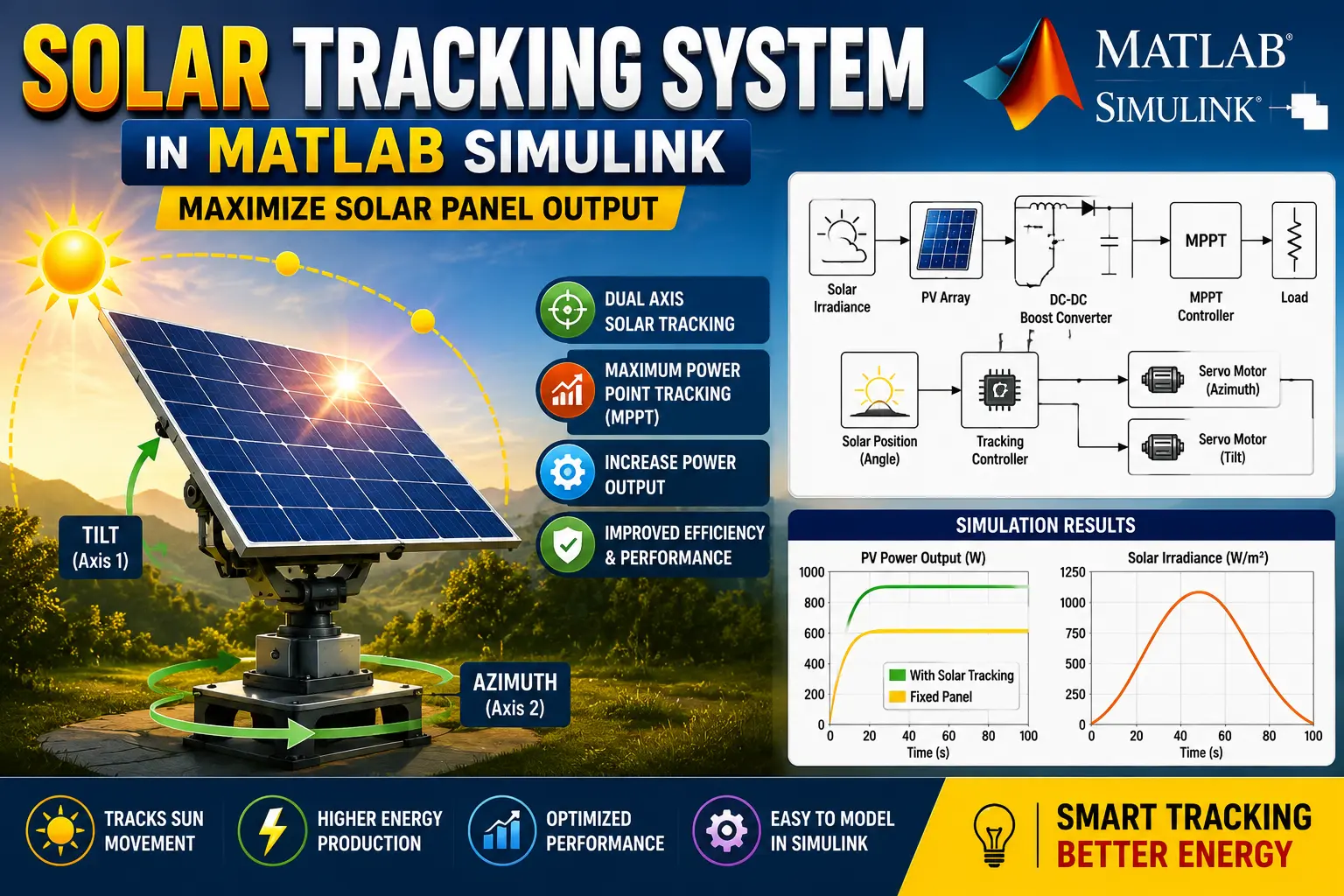
What is Solar Tracking System in MATLAB Simulink For Maximize Solar Panel Output?
Solar Tracking System in MATLAB Simulink For Maximize Solar Panel Output is a MATLAB-based technical project and simulation model. A Solar Tracking System is designed to maximize the energy captured by photovoltaic (PV) panels by continuously adjusting their orientation to follow the sun's movement throughout the day. Compared to fixed solar panels, solar tracking systems significantly improve energy generation, making them suitable for residential, commercial, and utility-scale solar power applications. In this MATLAB Simulink tutorial, we develop and simulate a complete solar tracking system capable of automatically adjusting the panel's tilt and azimuth angles. The model includes solar irradiance calculation, sun position estimation, tracking controller, servo motor actuator, photovoltaic array, Maximum Power Point Tracking (MPPT), DC-DC converter, and performance analysis. The simulation compares the output power of a fixed solar panel with that of a tracking system under varying environmental conditions.
Project Methodology
The Solar Tracking System is developed in MATLAB Simulink using the following methodology:
1. Solar Irradiance Modeling
- Simulate varying solar irradiance throughout the day.
- Model changes in sunlight intensity due to time and weather conditions.
2. Sun Position Calculation
- Determine the sun's azimuth and elevation angles.
- Generate the reference position for the tracking mechanism.
3. Tracking Controller
- Compare the desired and actual panel positions.
- Generate control signals for the tracking motors.
4. Servo Motor Control
- Simulate one or two servo motors for single-axis or dual-axis tracking.
- Continuously adjust the solar panel orientation.
5. Photovoltaic (PV) Array Modeling
- Develop a PV array model based on panel specifications.
- Analyze voltage, current, and output power.
6. MPPT Implementation
- Implement the Perturb and Observe (P&O) algorithm.
- Extract maximum power under changing irradiance conditions.
7. DC-DC Converter
- Regulate the PV output voltage.
- Supply stable power to the load or battery system.
8. Performance Analysis
Evaluate:
- PV output power
- Solar irradiance
- Tracking angle
- Panel orientation
- Tracking accuracy
- System efficiency
- Power improvement over a fixed panel
9. Result Comparison
- Compare fixed and tracking solar panels.
- Analyze percentage improvement in energy generation.
Verified MATLAB Simulation Code Demonstration
Syntax-highlighted executable code demonstration for Solar Tracking System in MATLAB Simulink For Maximize Solar Panel Output:
% Dynamic Physical Model & Solver Configuration
clc; clear; close all;

% Hydraulic & Mechanical ODE System Parameters
m = 1.0; c = 0.5; k = 9.0;
ode_sys = @(t, y) [y(2); -(c/m)*y(2) - (k/m)*y(1)];

% Numerical ODE Integration
tspan = [0 10]; y0 = [1.0; 0.0];
[t, y] = ode45(ode_sys, tspan, y0);

fprintf('ODE Physical System Solved across %d Time Steps!\n', length(t));