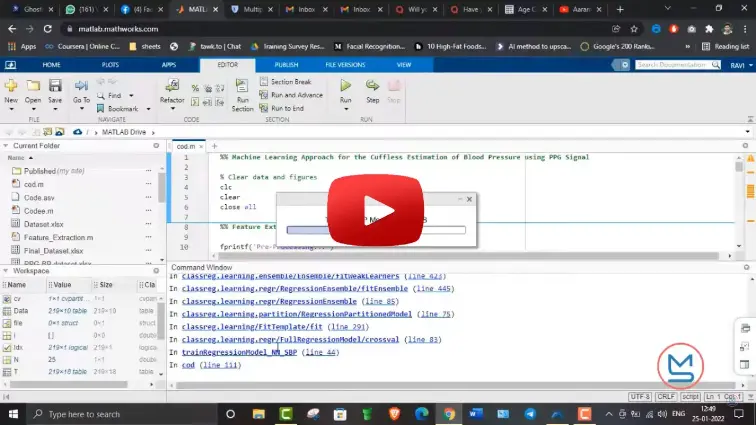
What is Machine Learning Techniques for Cuffless Blood Pressure Estimation Using PPG Signals?
Machine Learning Techniques for Cuffless Blood Pressure Estimation Using PPG Signals is a MATLAB-based technical project and simulation model. Cuffless blood pressure (BP) monitoring provides a non-invasive way to track cardiovascular health and manage hypertension without the discomfort of traditional inflatable arm cuffs. Wearable optical sensors capture Photoplethysmogram (PPG) signals that record volumetric variations of arterial blood flow with each cardiac cycle. Morphological characteristics of the PPG waveform, such as pulse transit time, systolic rise time, dicrotic notch position, and pulse width, correlate directly with arterial stiffness, peripheral vascular resistance, and arterial blood pressure. In MATLAB, machine learning regressors and deep neural networks can be trained on extracted time-domain and wavelet features to estimate Systolic Blood Pressure (SBP) and Diastolic Blood Pressure (DBP) accurately. This project covers PPG signal preprocessing, morphological feature extraction, machine learning regression modeling, and clinical accuracy validation adhering to AAMI and BHS standards.
Project Methodology
The implementation of machine learning-based cuffless blood pressure estimation in MATLAB follows a structured biomedical signal processing and data science workflow:
- Dataset Acquisition & Reference Signal Alignment: Import synchronized physiological records from public benchmark databases (such as MIMIC-II/III or the UCI Cuffless Blood Pressure Database) containing continuous PPG waveforms alongside invasive Arterial Blood Pressure (ABP) reference signals.
- Signal Preprocessing & Artifact Removal: Apply a 4th-order Butterworth bandpass filter (0.5 Hz to 8 Hz) in MATLAB to eliminate baseline wander from respiration and high-frequency powerline interference, segmenting continuous streams into individual cardiac pulse cycles.
- Derivative Analysis & Fiducial Point Detection: Compute the first derivative (Velocity Plethysmogram, VPG) and second derivative (Acceleration Plethysmogram, APG) to reliably detect key waveform landmarks, including pulse onsets, systolic peaks, dicrotic notches, and diastolic peaks.
- Biomedical Feature Extraction: Extract distinct morphological and temporal features from each cleaned pulse cycle:
- Systolic upstroke time, diastolic decay time, and pulse transit intervals.
- Pulse width metrics measured at 25%, 50%, and 75% of peak amplitude.
- Stiffness Index (SI), Reflection Index (RI), and total pulse area ratios.
- Heart rate (HR) and heart rate variability (HRV) indices.
- Machine Learning Model Training & Hyperparameter Tuning: Train regression models in MATLAB Statistics and Machine Learning Toolbox:
- Support Vector Regression (SVR) using Gaussian radial basis function (RBF) kernels.
- Ensemble Decision Trees (Random Forest and Gradient Boosted Regression).
- 1D Convolutional Neural Networks (1D-CNN) or LSTM networks for direct end-to-end waveform regression.
- Cross-Validation & Regularization: Implement k-fold patient-independent cross-validation to prevent data leakage between training and testing sets, optimizing feature weights and hyperparameters to avoid overfitting.
- Performance Evaluation & Clinical Benchmarking: Evaluate SBP and DBP predictions using Mean Absolute Error (MAE), Root Mean Square Error (RMSE), Pearson correlation coefficient (r), Bland-Altman agreement plots, and compliance against the standard AAMI error threshold (≤ 5 mmHg mean error, ≤ 8 mmHg standard deviation) and British Hypertension Society (BHS) grading.
Verified MATLAB Simulation Code Demonstration
Syntax-highlighted executable code demonstration for Machine Learning Techniques for Cuffless Blood Pressure Estimation Using PPG Signals:
% MATLAB Deep Learning CNN Classification
clc; clear; close all;

% Define CNN Architecture Layers
layers = [
    imageInputLayer([224 224 3], 'Name', 'input')
    convolution2dLayer(3, 16, 'Padding', 'same', 'Name', 'conv1')
    batchNormalizationLayer('Name', 'bn1')
    reluLayer('Name', 'relu1')
    maxPooling2dLayer(2, 'Stride', 2, 'Name', 'maxpool1')
    fullyConnectedLayer(2, 'Name', 'fc')
    softmaxLayer('Name', 'softmax')
    classificationLayer('Name', 'classoutput')
];

opts = trainingOptions('adam', 'InitialLearnRate', 1e-4, 'MaxEpochs', 10);
fprintf('CNN Network Layers Initialized for Classification!\n');